
Hormone Clinic or Endocrinologist? How to Choose | BIOELITE
Educational content only. This article does not diagnose, treat, or prescribe, and it does not promise outcomes. Always discuss personal medical decisions with a licensed clinician. Individual results vary.
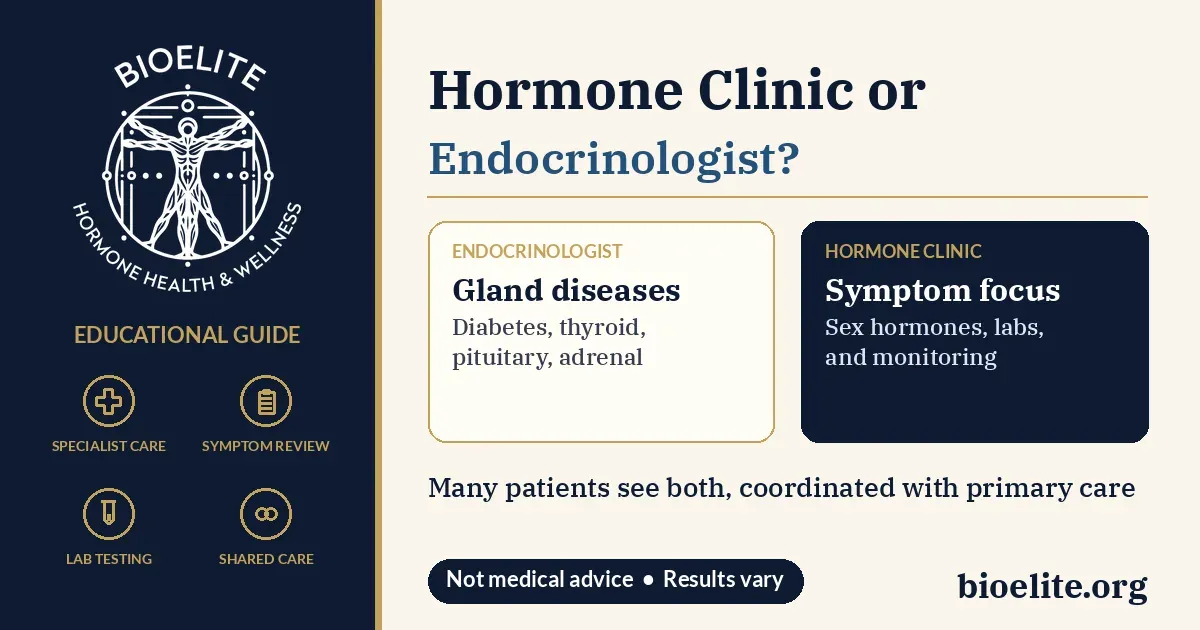
Quick answer: An endocrinologist is a physician trained to diagnose and treat diseases of the hormone glands, such as diabetes and thyroid, pituitary, adrenal, and bone disorders. A hormone clinic usually focuses on symptoms tied to sex hormones, such as low testosterone or menopause, with lab testing and regular monitoring. Many people use both, coordinated with primary care.
Last updated: October 23, 2026. Reviewed by the BIOELITE clinical team.
If you are searching for a hormone clinic in Boynton Beach or a hormone doctor in Boynton Beach, you may be wondering whether you need an endocrinologist instead. Both play valuable roles, and they are not interchangeable. This guide explains what each one typically handles, the situations where an endocrinologist is usually the right first stop, and how to choose the starting point that fits your health picture.
What does an endocrinologist do?
The endocrine system is a set of glands that make hormones. The MedlinePlus overview of endocrine diseases, from the National Library of Medicine, notes that diabetes is the most common endocrine disease in the United States. According to the American Association of Clinical Endocrinology, an endocrinologist is a physician who specializes in diagnosing and treating hormone-related diseases. Conditions they commonly manage include diabetes, thyroid disorders, osteoporosis, adrenal disorders, lipid and metabolic problems, and conditions affecting sexual function and reproduction.
The American College of Physicians describes endocrinology as a subspecialty of internal medicine. Training adds two years of fellowship after an internal medicine residency, and graduates are eligible for board certification by the American Board of Internal Medicine. Endocrinologists also evaluate pituitary tumors, parathyroid and calcium problems, and gonadal disorders such as hypogonadism, and they often consult for other physicians and hospitals.
What a hormone clinic focuses on
A hormone clinic is narrower by design. At BIOELITE Hormone Health and Wellness, a Licensed Provider reviews symptoms, history, and lab results related to sex hormones and weight management, then talks through options and follow-up. Services include hormone replacement therapy for menopause and perimenopause, testosterone therapy and alternatives, medical weight management, sexual health care, peptide therapy, and lab testing.
The focus is on symptom-driven evaluation, properly timed labs, and steady monitoring rather than the full range of gland diseases an endocrinologist treats. A good hormone clinic also recognizes when lab results point beyond its scope and refers to a specialist.
When an endocrinologist is usually the right first stop
Some situations call for specialist evaluation from the start, or for a referral as soon as they come up. These are common examples:
Diabetes, especially when insulin or frequent medication changes are involved. Glucose and lipid markers can show up on a hormone panel, as our guide to A1C and lipids on a hormone panel explains, but ongoing diabetes care usually stays with primary care or endocrinology.
Thyroid disease, such as an overactive or underactive thyroid, goiter, or thyroid nodules. Our article on thyroid labs such as TSH and free T4 explains common results, which are reviewed with primary care or endocrinology.
A known or suspected pituitary problem. A markedly high result in prolactin labs or a pattern in LH and FSH labs that suggests a pituitary cause is a common reason for referral.
Possible adrenal disorders. Our explainer on cortisol labs in a hormone workup covers why abnormal results need careful specialist follow-up.
Osteoporosis, or calcium and parathyroid problems.
When a hormone clinic evaluation may fit
For many adults, the first concern is a change in how they feel rather than a known gland disease. A hormone clinic evaluation may be a reasonable starting point if you are:
A man noticing signs of low testosterone in men over 40, such as lower libido, less energy, or mood changes, with no known pituitary or other gland disease.
A woman in midlife with symptoms covered in our perimenopause hormone evaluation guide, or comparing menopause treatment options.
Looking for structured lab work and follow-up, such as a complete hormone lab panel reviewed by a Licensed Provider.
Menopause care in particular is provided by many kinds of clinicians. The Menopause Society guide to choosing a healthcare practitioner notes that physicians, nurse practitioners, physician assistants, and other licensed professionals can earn its menopause credential.
How the two can work together
A hormone clinic and an endocrinologist are not competitors. Many patients see both. For example, a clinic evaluation may uncover an unusual result that leads to an endocrinology referral, while the endocrinologist manages the underlying condition and the clinic continues the parts of care that fit its scope, with both sharing records.
Before treatment is discussed, BIOELITE first considers whether the cause is something that needs a different specialist, and whether the body's own production can be supported. Read more about hormone stimulation versus replacement.
Where primary care fits
Your primary care clinician often sees the whole picture: blood pressure, heart health, cancer screening, and every medication you take. Keep them informed about hormone evaluations and results from any clinic or specialist. They can also help decide whether a referral to endocrinology makes sense and keep records from different offices together in one place.
Questions to help you choose a starting point
Do I already have a diagnosed gland condition, such as diabetes, thyroid disease, or a pituitary problem? If so, start with your endocrinologist or primary care clinician.
Have earlier labs shown a markedly abnormal result that no one has explained yet?
Is my main concern a change in libido, energy, mood, sleep, or menopause symptoms, without a known gland disease?
Will the clinicians I see share results and coordinate with each other?
If you are comparing hormone clinics on quality, our guide on how to evaluate a hormone clinic covers what to look for in the clinical process.
Seeing BIOELITE in Boynton Beach or by telehealth
Our office is at 1101 N. Congress Avenue, Suite 100, Boynton Beach, FL 33426, serving Palm Beach County. In-person visits are by appointment only, Monday through Friday, 9 AM to 5 PM; walk-ins are not available. You can find our Boynton Beach office on Google Maps, and our Boynton Beach hormone therapy guide covers local visits in more detail.
Telehealth video visits are available until 8 PM for patients in states where our Licensed Providers are licensed, and eligibility rules apply. Our guide to online TRT evaluation by telehealth shows how a video visit works. Labs are currently ordered through Quest Diagnostics.
Practical next steps
List any diagnosed conditions and every prescription and supplement you take.
Gather earlier lab results, including the date and time of day each was drawn.
Write down your main symptoms and roughly when each began.
Note the names of any specialists you already see so records can be shared.
New patients can book at our online booking page, call (561) 821-3005, or use our contact page. Process questions are answered on our FAQ.
Existing clients can use our existing-client booking page.
Browse more in our Hormone Health Guides or see all health guides.
Frequently asked questions about hormone clinics and endocrinologists
Is a hormone clinic the same as an endocrinologist?
No. An endocrinologist is a physician with internal medicine training plus a fellowship in endocrinology who treats diseases of the hormone glands. A hormone clinic usually focuses on symptom-based evaluation of sex hormones, with lab testing and ongoing monitoring by a Licensed Provider.
Should I see an endocrinologist for low testosterone?
It depends on the cause. Low testosterone linked to a known pituitary problem, very unusual lab results, or other gland disease is often referred to endocrinology. Many men with symptoms and no known gland disease start with primary care or a hormone clinic evaluation.
Can I see a hormone clinic and an endocrinologist at the same time?
Yes, as long as both clinicians know about each other. Share your lab results and medication list with every clinician, and ask that records be sent between offices so care stays coordinated.
Does BIOELITE offer telehealth visits?
Yes. Telehealth video visits are available until 8 PM for patients in states where our Licensed Providers are licensed, and eligibility rules apply. In-person visits at our Boynton Beach office are by appointment only.
Medical disclaimer: This article is general education, not medical advice. It does not diagnose any condition, recommend medications or doses, or tell you to start, stop, or change any medication. It does not replace care from your endocrinologist, primary care clinician, or other specialists. Testing and treatment decisions require a licensed clinician. Individual results vary. Care depends on clinical eligibility and licensure; please confirm visit hours when scheduling.