
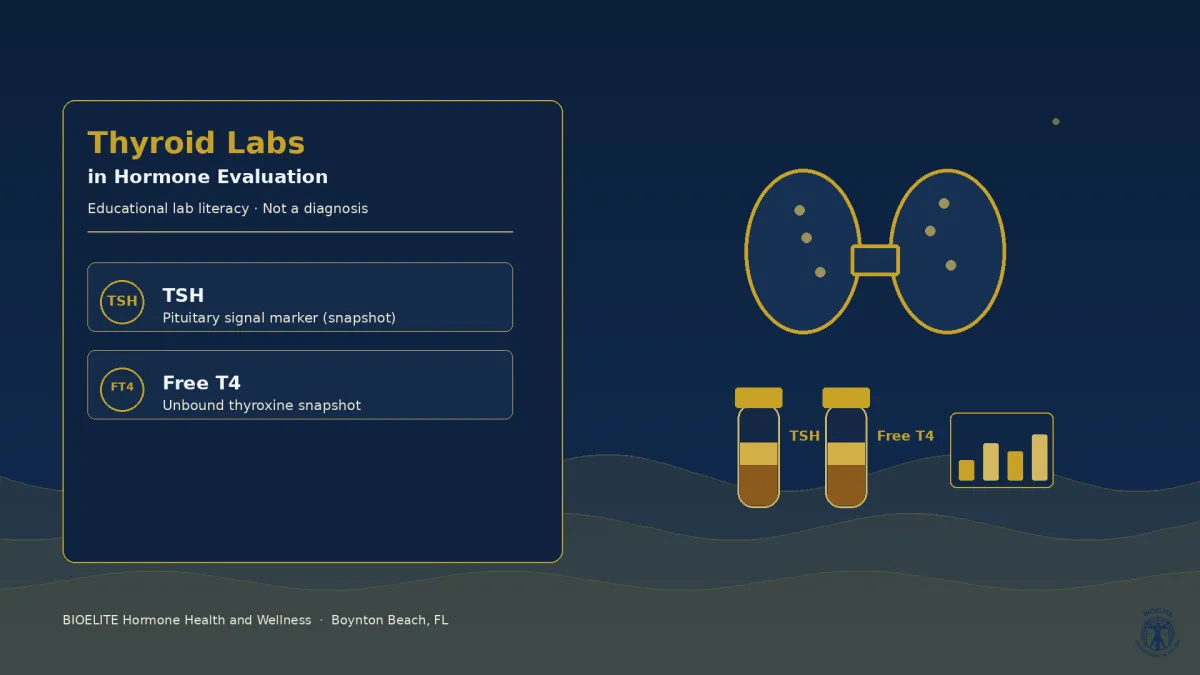
Thyroid Labs in Hormone Evaluation: TSH and Free T4
Educational content only. This article does not diagnose, treat, prescribe, or guarantee outcomes. Always discuss personal medical decisions with a licensed clinician. Individual results vary.
Thyroid Labs in Hormone Evaluation: TSH and Free T4
When people search for thyroid labs hormone evaluation, they often want to know why thyroid markers appear alongside testosterone, estrogen, or broader wellness panels. Fatigue, weight change, mood shifts, and low libido can have more than one contributing pathway. Clinicians frequently review thyroid markers such as TSH and Free T4 as part of a wider picture—not as a stand-alone diagnosis from a blog post.
This guide is educational lab literacy for readers in Boynton Beach, Palm Beach County, and greater South Florida. It explains what TSH and Free T4 generally represent, how they may relate conceptually to energy and metabolism context, and when it may be appropriate to ask a licensed clinician for supervised evaluation. It is not a substitute for medical advice, and it does not claim that thyroid markers “cause” low testosterone or guarantee any treatment outcome.
For panel context beyond thyroid markers alone, see our guides on a complete hormone lab panel, free vs total testosterone lab numbers, and LH and FSH labs in low testosterone evaluation.
Why thyroid markers often appear in hormone workups
Hormone evaluation is rarely about a single number. Energy, recovery, body composition, and sexual health can be influenced by sleep, stress, nutrition, medications, and multiple endocrine axes. Thyroid signaling helps regulate metabolic pace in many people. That is why a clinician reviewing concerns that sound “hormone-related” may also order or review thyroid markers—especially when symptoms overlap with common thyroid-related complaints (such as unusual fatigue or unexplained weight change), or when a broader baseline is clinically appropriate.
Including thyroid markers does not mean every fatigue story is a thyroid problem, and it does not mean low testosterone is “just thyroid.” Markers help a licensed clinician build context; interpretation depends on history, medications, exam findings when performed, and other labs.
At BIOELITE Hormone Health and Wellness, lab work supports clinical decision-making when ordered. Learn more about our approach on the lab testing page. One draw does not diagnose or prescribe.
What TSH generally represents (education, not diagnosis)
TSH (thyroid-stimulating hormone) is produced by the pituitary gland. In broad educational terms, TSH helps signal the thyroid gland. Lab reports often list a reference range; where a result sits relative to that range is one data point a clinician may consider alongside symptoms and other tests.
TSH is often used as a screening-oriented thyroid marker in many clinical settings.
A result inside a lab’s reference range does not automatically mean you feel well—and a result outside a range does not, by itself, equal a complete diagnosis from this article.
Timing, biotin supplements, acute illness, certain medications, and lab method differences can sometimes affect results. Your clinician decides what to recheck or expand.
This section is literacy only. Do not self-interpret a TSH value into a treatment plan.
What Free T4 generally represents
Free T4 refers to the unbound portion of thyroxine (T4) circulating in blood—the fraction that is not attached to binding proteins and is more immediately available to tissues in educational descriptions of thyroid hormone transport. Clinicians may review Free T4 together with TSH to form a more complete thyroid snapshot than either marker alone.
Free T4 is often paired with TSH rather than read in isolation.
Some evaluations may include additional thyroid-related tests when clinically indicated (for example Free T3 or antibody markers). What is ordered is clinician-directed—not a checklist you should invent for yourself.
Reference ranges and units can differ by laboratory. Compare results to the range printed on your report, and discuss them with a licensed professional.
Again: education only. Free T4 numbers alone do not prescribe medication or prove a cause of low energy.
Thyroid context, energy, and metabolism—without overclaiming
People often connect thyroid function with energy, temperature comfort, and metabolism. Those associations are commonly discussed in clinical education, but individual experiences vary widely. Overlap with symptoms people attribute to low testosterone, menopause-related change, sleep debt, or stress does not prove causation in either direction.
In practical terms:
Thyroid markers may help a clinician rule in or out pathways that deserve attention.
Sex-hormone markers (such as total/free testosterone, LH/FSH, or estradiol when ordered) answer related but different questions—see our posts on free vs total testosterone and LH/FSH evaluation.
A thoughtful workup may look at both domains when symptoms and history suggest it—under medical supervision, not via online self-treatment.
For broader energy and vitality screening framing, see hormone screening for energy and vitality. If you are comparing evaluation costs before any treatment quote, our companion guide on HRT and TRT cost: labs and consults before treatment maps the cash-pay ladder.
What a supervised hormone evaluation may include
Exact testing varies by clinician order, sex, age, medications, symptoms, and prior results. Educational examples of what a supervised evaluation may include:
History and goals discussion with the care team and/or a licensed clinician
Baseline labs when ordered—often including sex hormones and, when appropriate, thyroid markers such as TSH and Free T4
Review of results in context (not a raw “pass/fail” email)
Follow-up testing if monitoring or clarification is needed
Pathways related to hormone replacement therapy or testosterone therapy—if ever considered—start with evaluation. A consultation does not guarantee a prescription. Medication, when clinically appropriate, is separate from lab literacy.
Telehealth availability depends on applicable requirements and clinician licensure for your location. Patients in Boynton Beach and Palm Beach County can ask about in-person versus remote options when they reach out; do not assume interstate coverage.
When to ask a licensed clinician
Consider contacting a licensed clinician if you have persistent unexplained fatigue, significant weight change, temperature intolerance, hair or skin changes, menstrual irregularities, sexual health concerns, or other symptoms that worry you—especially if you already have lab results you do not fully understand. Bring prior reports when possible; your clinician decides what to repeat or add.
Urgent or emergency symptoms require emergency care—not a blog CTA.
Practical next steps
Review our lab testing overview for how panels support evaluation.
Read related literacy posts on complete panels, free vs total testosterone, and LH/FSH if those questions apply to you.
Confirm current cash-pay fees on pricing (specials may change).
Ask questions via the FAQ or a free team consult for process clarity—remember a team consult is not a medical evaluation.
Schedule a licensed clinician conversation when you are ready for supervised interpretation.
Ready to talk through labs for your situation? Call (561) 821-3005 or use the contact form. Soft CTA only: we do not diagnose or prescribe in this article.
Medical disclaimer: This article is for general education only and is not medical advice. It does not diagnose thyroid disease, hypogonadism, or any other condition; it does not recommend doses, promise results, or instruct self-treatment. Hormone and thyroid evaluation and any treatment decisions require a licensed clinician. Individual results vary. Laboratory methods and reference ranges differ. Availability of in-person and telehealth care depends on clinical and regulatory factors. Fees and laboratory specials may change—confirm current amounts with BIOELITE before scheduling.
