
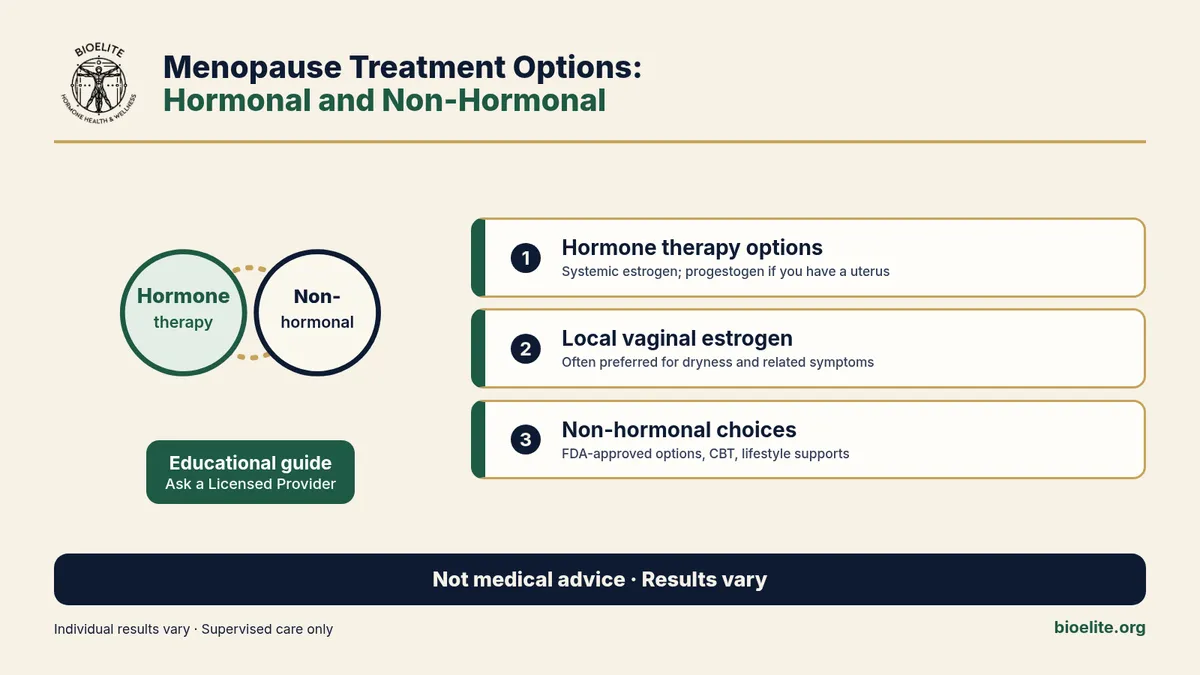
Menopause Treatment Options: Hormonal and Non-Hormonal
Educational content only. This article does not diagnose, treat, or prescribe, and it does not promise outcomes. Always discuss personal medical decisions with a licensed clinician. Individual results vary.
If you are searching for menopause treatment, you are usually looking for a clear map of options, not a sales pitch. Hot flashes, night sweats, sleep disruption, mood changes, and vaginal dryness can make daily life harder. Some people want hormone therapy. Others cannot take hormones, prefer not to, or need a different approach for genitourinary symptoms alone.
This guide explains common menopause treatment options in plain language: systemic hormone therapy, low-dose vaginal estrogen for genitourinary symptoms, FDA-approved versus compounded "bioidentical" products, and evidence-based non-hormonal choices. It also covers who may not be a candidate, the usual role of labs, and when to see a Licensed Provider. It is educational only. Care decisions belong in a supervised visit.
Readers in Boynton Beach and Palm Beach County can use the same framework locally; BIOELITE also supports eligible patients by telehealth where clinicians are licensed. Soft eligibility and licensure rules always apply.
What "menopause treatment" usually means
Menopause is a natural life stage. Treatment is not required for everyone. Care focuses on bothersome symptoms and related health questions, not on "fixing" menopause itself.
According to The Menopause Society (formerly the North American Menopause Society), hormone therapy remains the most effective treatment for vasomotor symptoms (hot flashes and night sweats) and for many genitourinary symptoms of menopause. Non-hormonal prescriptions, cognitive-behavioral therapy, and lifestyle supports also matter when hormones are not a fit.
Perimenopause, the transition years before the final menstrual period, can bring similar symptoms with irregular cycles. Our related guide on perimenopause hormone evaluation focuses on signs and how evaluation works. This article focuses on treatment-option literacy after menopause symptoms are already front and center.
Hormone therapy options
Systemic estrogen, with a progestogen if you have a uterus
Systemic hormone therapy delivers estrogen to the whole body (pill, patch, gel, or spray). It is commonly discussed for moderate to severe hot flashes and night sweats in appropriate candidates.
If you still have a uterus, guidelines generally call for a progestogen with estrogen to protect the uterine lining. After hysterectomy, estrogen alone may be considered when hormone therapy is appropriate. Product choice, dose, and duration are clinical decisions. This article does not recommend doses or protocols.
The Menopause Society's 2022 hormone therapy position statement notes that for healthy symptomatic women younger than 60, or within about 10 years of menopause onset, the benefit-risk balance is often favorable for bothersome vasomotor symptoms when there are no contraindications. Starting later, or after age 60, is generally less favorable because absolute risks of coronary heart disease, stroke, blood clots, and dementia can be higher. Shared decision-making and periodic reassessment are part of responsible care.
Low-dose vaginal estrogen for genitourinary symptoms
Genitourinary syndrome of menopause can include vaginal dryness, discomfort with sex, and some urinary symptoms. When those local symptoms are the main problem, low-dose vaginal estrogen (cream, tablet, or ring) is often preferred over whole-body hormone therapy because less hormone is absorbed systemically. Over-the-counter moisturizers and lubricants are common first-line comfort measures. Other options for certain symptoms may include products such as ospemifene or vaginal prasterone. Fit is a Licensed Provider decision.
FDA-approved hormone therapy vs compounded "bioidentical" products
Many searches for menopause treatment also mention bioidentical hormones. The U.S. Food and Drug Administration (FDA) explains that many products marketed as "bioidentical hormones" are compounded drugs that are not FDA-approved. The FDA does not have evidence that compounded "bioidentical hormones" are safe and effective, or safer or more effective than FDA-approved hormone therapy. Some FDA-approved hormone medicines do contain hormones chemically identical to those made by the ovaries during reproductive years.
Ask your Licensed Provider which products are FDA-approved and which are compounded, and ask about risks and benefits for your history. Our hormone replacement therapy page and related bioidentical literacy posts can help you prepare questions. This guide does not claim any compounded product is superior.
Non-hormonal treatment options
Hormone therapy is not the only path. The Menopause Society's 2023 nonhormone therapy position statement reviews evidence for several approaches for vasomotor symptoms.
FDA-approved nonhormonal medicines for hot flashes. Major sources discuss fezolinetant (a neurokinin-3 pathway medicine) and a low-dose paroxetine product approved for moderate to severe vasomotor symptoms. Other SSRI/SNRI medicines also have evidence for hot-flash reduction. Your provider weighs benefits, side effects, interactions, and any monitoring needs.
Other prescription options with evidence. Gabapentin and, in selected cases, oxybutynin appear in the 2023 statement. Suitability is individual.
Mind-body approaches with stronger evidence. Cognitive-behavioral therapy (CBT) and clinical hypnosis have strong support in the 2023 statement for vasomotor symptoms.
Lifestyle context. Weight management, sleep routines, and trigger awareness can help some people. The 2023 statement does not recommend many popular supplements and herbal products for hot flashes based on the evidence reviewed there.
Non-hormonal care is especially important when hormone therapy is contraindicated, declined, or deferred. It is also useful when vasomotor symptoms persist and a different tool is needed.
Who may not be a candidate for hormone therapy
Hormone therapy is not for everyone. The FDA and clinical summaries flag situations where it may be inappropriate or needs special caution, such as unexplained vaginal bleeding, certain cancers, history of stroke or heart attack, history of blood clots, liver disease, or known or suspected pregnancy. Age, time since menopause, family history, and medications also matter.
A Licensed Provider reviews your full history before any treatment discussion. Symptoms alone do not mean hormones are appropriate. Declining hormones also does not mean you have no options.
How labs fit in (and what they usually do not do)
Diagnosis of menopause is usually clinical: menstrual change culminating in 12 months without a period in the typical age range, plus symptoms. Routine hormone labs are not always required to confirm menopause in midlife.
Labs still help in selected situations: earlier-than-expected symptoms, uncertainty about ovarian function, ruling out look-alike conditions, or baseline safety checks before or during therapy. Related posts on estradiol labs for women, the complete hormone lab panel, and how to prepare for hormone bloodwork explain how supervised labs support evaluation without turning results into a DIY diagnosis.
BIOELITE currently uses Quest Diagnostics for ordered lab draws. Confirm collection details before you go. Do not stop any medication for a lab test unless your clinician tells you to.
When to see a Licensed Provider
Consider a visit if hot flashes, night sweats, sleep loss, mood changes, or vaginal dryness are affecting your quality of life; if bleeding patterns change in ways that worry you; if you have tried over-the-counter comfort measures without enough relief; or if you want a structured review of hormonal versus non-hormonal options for your history.
Seek urgent or emergency care for sudden severe symptoms that could signal a medical emergency. A blog post is not urgent care.
At BIOELITE, in-person visits at the Boynton Beach office (1101 N. Congress Ave, Suite 100) are by appointment only, Monday through Friday, 9 AM to 5 PM. Telehealth video visits are available until 8 PM in states where our providers are licensed, and all states will be available soon. Messages are answered 24 hours a day. Call (561) 821-3005 or use our contact page. Process questions are covered on our FAQ and fee overview on our pricing page. Local readers may also find our Boynton Beach hormone therapy guide and Palm Beach County page helpful for logistics.
Practical next steps
Write down your main symptoms, when they started, and what has already been tried.
List medications, supplements, surgeries (including hysterectomy), and relevant family history.
Gather recent labs with dates, if you have them.
Decide whether an in-person Boynton Beach visit or a telehealth visit fits your situation better.
Bring questions about FDA-approved versus compounded products, non-hormonal options, and follow-up monitoring.
A first visit is a starting point for an informed decision. It is not a commitment to any treatment.
Medical disclaimer: This article is for general education only and is not medical advice. It does not diagnose menopause or any other condition; it does not recommend doses, products, or self-directed protocols; and it does not instruct you to start, stop, or change any medication or supplement. Position-statement and regulatory summaries reflect publicly available Menopause Society, FDA, Office on Women's Health, and Mayo Clinic educational materials as of October 2026 and may change. Evaluation and any testing or treatment decisions require a licensed clinician. Individual results vary. Availability of in-person and telehealth care depends on clinical eligibility and applicable licensure. Visit hours may change; please confirm when scheduling.
