
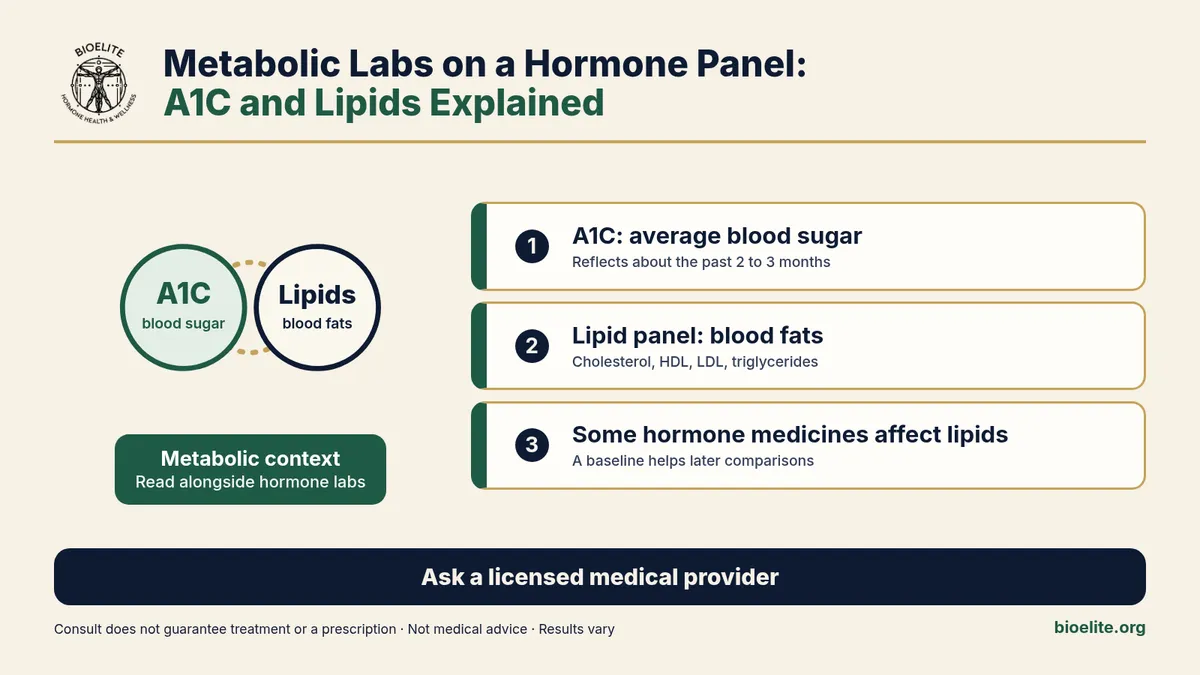
Metabolic Labs on a Hormone Panel: A1C and Lipids Explained
Educational content only. This article does not diagnose, treat, or prescribe, and it does not promise outcomes. Always discuss personal medical decisions with a licensed clinician. Individual results vary.
When people think about hormone testing, they usually picture testosterone, estradiol, or thyroid numbers. So it can be a surprise to see hemoglobin A1C, cholesterol, and triglycerides on the same lab order. These metabolic labs are not there by accident. They help a clinician understand the background your hormones are working against, and they can shape which questions are worth asking before any care decision is made.
This guide is a closer look at two groups of metabolic labs: A1C and the lipid panel. It explains why they show up in hormone, testosterone, hormone replacement, and weight evaluations, what each test measures, how results relate to symptoms and long-term risk, and which questions to bring to a Licensed Provider. If you want the big-picture view of everything a hormone panel can include, start with our complete hormone lab panel guide. This article goes deeper on these specific markers.
Why metabolic labs belong in a hormone workup
Hormones and metabolism are closely connected. Insulin, body fat, blood sugar, and blood fats all interact with sex hormones and with the proteins that carry them in the blood. A 2014 review in the Asian Journal of Andrology, for example, describes how higher insulin levels in men with excess weight can lower sex hormone binding globulin (SHBG), which in turn lowers total testosterone results.
There are three common reasons metabolic labs appear on a hormone order:
Context for symptoms. Fatigue, weight gain around the middle, and low energy can overlap with hormone changes, blood sugar problems, and other conditions. Metabolic labs help sort out what may be contributing.
A baseline for heart and metabolic risk. The American Urological Association (AUA) testosterone deficiency guideline says clinicians should assess men with testosterone deficiency for cardiovascular risk factors, including modifiable ones such as abnormal blood fats, high blood pressure, diabetes, and smoking.
Monitoring over time. FDA labeling for some hormone medicines describes effects on blood fats, so knowing where you started makes later results easier to interpret.
What A1C measures
Hemoglobin A1C, often written HbA1c or just A1C, measures how much sugar has attached to hemoglobin, the protein in red blood cells. Because red blood cells live for about 120 days, the American Diabetes Association (ADA) Standards of Care describe A1C as a measure of average glucose exposure over roughly the past two to three months. That makes it different from a fasting glucose test, which captures a single moment.
A few practical points from the ADA Standards of Care in Diabetes 2026:
A1C does not require fasting, and recent meals, stress, or activity do not change it the way they change a glucose reading.
Conditions that change red blood cell turnover can make A1C less reliable. Examples listed include anemia, iron status, recent blood loss, transfusion, kidney failure, pregnancy, and some hemoglobin variants.
When A1C and glucose results do not match, the ADA advises looking for a reason, such as an interference with one of the tests.
A1C reference ranges, for context only
For nonpregnant adults, the ADA uses these A1C categories: below 5.7 percent is considered normal, 5.7 to 6.4 percent falls in the prediabetes range, and 6.5 percent or higher meets the diabetes criterion. The ADA also notes that, without clear symptoms, a result in the diabetes range needs to be confirmed with a repeat test or a second type of test, and that risk rises continuously across the range rather than switching on at a single number.
These ranges are reference context, not a personal target. Only a clinician who knows your history can explain what your own result means and whether more testing makes sense.
Why A1C comes up in testosterone and weight evaluations
The AUA guideline notes that the evidence linking low testosterone and diabetes is mixed. Even so, it says measuring A1C should be considered in middle-aged or older men with low testosterone who also have obesity, metabolic syndrome, or long-term corticosteroid exposure, and that an abnormal result should prompt referral for further evaluation. Our article on low testosterone and belly fat explains how excess weight and testosterone can affect each other.
It also helps to know what testosterone does not do. In its review of randomized trials, the AUA panel found no significant difference in A1C between men treated with testosterone and men in control groups. Testosterone is not a diabetes treatment, and blood sugar concerns deserve their own evaluation.
For adults considering weight care, the ADA recommends that adults with overweight or obesity and one or more risk factors be considered for prediabetes and type 2 diabetes testing, and that testing begin by age 35 for everyone else. That is one reason A1C often appears in a medical weight management evaluation.
What a lipid panel measures
A lipid panel, also called a lipid profile or lipoprotein panel, measures fats in the blood. According to MedlinePlus from the National Library of Medicine and the National Heart, Lung, and Blood Institute (NHLBI), a standard panel usually includes:
Total cholesterol, the overall amount of cholesterol in the blood.
LDL cholesterol, often called "bad" cholesterol because high levels can lead to plaque buildup in the arteries.
HDL cholesterol, often called "good" cholesterol because it helps carry cholesterol back to the liver for removal.
Triglycerides, a type of fat in the blood. High levels may raise the risk of heart disease, and very high levels can also raise the risk of pancreatitis.
Some lab reports also show non-HDL cholesterol, which is total cholesterol minus HDL. MedlinePlus notes that you may be asked to fast for 9 to 12 hours before a cholesterol test, but not always. Follow the instructions for your specific order, and see our guide on how to prepare for hormone bloodwork for general tips.
How often a lipid panel is repeated depends on your age, risk factors, and family history, according to NHLBI. A Licensed Provider can explain what interval fits your situation.
How lipids connect to TRT and HRT
Testosterone therapy
FDA labeling for testosterone products states that changes in the blood lipid profile may occur and that lipids should be monitored periodically, particularly after therapy starts or changes. That is why a baseline lipid panel is common before testosterone therapy is considered, and why lipids are often rechecked during follow-up. Lipids are only one part of monitoring. Our guide to hematocrit monitoring on TRT covers another.
Hormone replacement therapy for women
FDA labeling for oral estradiol tablets lists effects on blood fats, including higher HDL, lower LDL, and higher triglycerides, and warns that in people with existing high triglycerides, estrogen therapy may raise triglycerides further and lead to pancreatitis. Effects can differ by medicine and route, so a Licensed Provider reviews your lipid history before discussing hormone replacement therapy options.
How A1C and lipids relate to symptoms and risk
You usually cannot tell your A1C or cholesterol by how you feel. The ADA notes that type 2 diabetes frequently goes undetected for many years because blood sugar rises gradually and, at earlier stages, may not cause the classic symptoms. That is why these markers are measured rather than guessed.
These labs also tend to travel together. NHLBI describes metabolic syndrome as having three or more of the following: a large waistline, high blood pressure, high blood sugar, high triglycerides, and low HDL cholesterol. The ADA notes that prediabetes is associated with abdominal obesity, high triglycerides or low HDL, and high blood pressure. When several of these show up at once, a clinician may look at the bigger picture rather than any single number.
What these results cannot do on their own is explain every symptom or decide on a treatment. A normal A1C does not rule out a hormone issue, and an abnormal lipid panel does not mean hormone care is or is not appropriate. Results are one input alongside your symptoms, history, medications, and goals.
Questions to bring to a Licensed Provider
Why are A1C and a lipid panel part of my hormone or weight evaluation?
Do I need to fast for this lab order, and should I take my usual medications that morning?
Is there anything in my history, such as anemia, recent blood loss, or kidney disease, that could affect my A1C result?
How do my results compare with my previous labs, and what is the trend?
If hormone therapy is ever considered, how could it affect my lipids, and how often would they be rechecked?
Should any result be followed up with my primary care clinician or a specialist?
Which lifestyle factors, such as sleep, activity, alcohol, and eating patterns, are worth discussing based on these numbers?
A careful clinic welcomes these questions and gives qualified, realistic answers.
How BIOELITE approaches metabolic labs in hormone care
BIOELITE Hormone Health and Wellness sees patients in person at our Boynton Beach office, 1101 N Congress Ave, Suite 100, by appointment only, and offers telehealth video visits for eligible patients. Care starts with a Licensed Provider evaluation of your symptoms, history, medications, and goals. Which labs make sense, including whether metabolic markers are included, depends on that evaluation.
BIOELITE currently uses Quest Diagnostics for lab draws, and patients may also use LabCorp. Our lab testing page explains how lab work fits into an evaluation. Telehealth care is available where clinically appropriate and permitted in your state, subject to applicable clinician licensure for your location. For current fees, please see our pricing page.
Practical next steps
Gather any recent A1C, glucose, and lipid results, with the dates they were drawn.
Note whether you were fasting for past lipid tests.
List every medication and supplement you take.
Write down your symptoms and any family history of diabetes, high cholesterol, or early heart disease.
Bring the questions above to a visit with a Licensed Provider, in person in Boynton Beach or by telehealth.
Have questions about metabolic labs in hormone care? Call (561) 821-3005 or reach us through our contact page.
Medical disclaimer: This article is for general education only and is not medical advice. It does not diagnose any condition; it does not recommend doses, products, or self-directed protocols; it does not set lab targets; and it does not instruct you to start, stop, or change any medication or supplement. Reference ranges described here come from public ADA, NIH, and FDA sources as of October 2026 and may change; laboratories may report different ranges. Evaluation and any testing or treatment decisions require a licensed clinician. A consultation does not guarantee treatment or a prescription. Individual results vary. Availability of in-person and telehealth care depends on clinical eligibility and applicable licensure.
