
Low Testosterone and Belly Fat: What Men Should Know
Educational content only. This article does not diagnose, treat, or prescribe, and it does not promise outcomes. Always discuss personal medical decisions with a licensed clinician. Individual results vary.
Many men notice two changes around the same time: their waistline grows, and they start to wonder whether their testosterone is low. Online, the answer often sounds simple. One video says low testosterone causes belly fat, the next presents testosterone as the fix. The real picture is more useful than either claim.
This guide explains what researchers mean when they describe a two-way link between low testosterone and belly fat, why a single lab number can mislead, why testosterone is not a weight-loss treatment, and which questions are worth bringing to a Licensed Provider. It is written for men across the United States, with local context for readers in Boynton Beach, Palm Beach County, and South Florida.
Why men ask about low testosterone and belly fat
Testosterone helps regulate muscle, bone, red blood cell production, sex drive, and how the body stores fat. When men see more fat around the middle, less muscle, lower energy, or a lower sex drive, low testosterone is a natural question to ask. Those changes can overlap with low testosterone, but they also overlap with sleep problems, stress, alcohol, less activity, some medications, and normal aging.
Belly fat is not all the same
Fat around the abdomen sits in two main places. Subcutaneous fat lies just under the skin. Visceral fat sits deeper, around the organs inside the abdomen. Medical research links visceral fat more closely with heart and metabolic risk than fat under the skin.
You cannot measure visceral fat precisely at home, but waist size is a practical clue. The National Heart, Lung, and Blood Institute (NHLBI) notes that carrying most of your fat around the waist rather than the hips raises the risk of heart disease and type 2 diabetes, and that a waist measurement of more than 40 inches increases risk for men. To measure, NHLBI suggests standing, placing a tape measure around your middle just above the hipbones, and measuring just after you breathe out.
How low testosterone and belly fat can affect each other
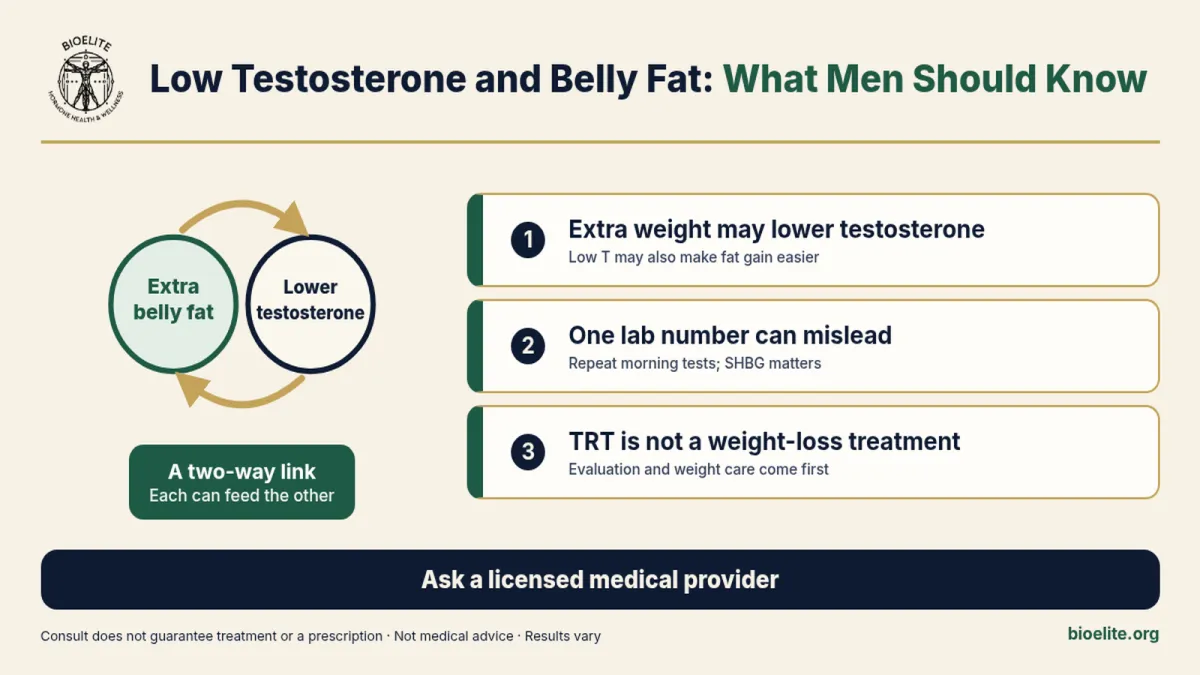
A 2014 review in the Asian Journal of Andrology describes the relationship as two-way. Extra body fat can push testosterone down, and low testosterone can make it easier to gain fat and lose muscle. Each side can feed the other, which is why researchers sometimes call it a self-perpetuating cycle.
How extra body fat may lower testosterone
Lower SHBG. Excess weight and higher insulin levels can lower sex hormone binding globulin (SHBG), the protein that carries much of the testosterone in the blood. Lower SHBG can pull total testosterone down even when free testosterone is closer to normal. Our guide to SHBG and testosterone binding explains this in more detail.
Signals from fat tissue. Visceral fat releases inflammatory signals and hormones that may quiet the brain signals telling the testes to make testosterone.
Estrogen conversion. Fat tissue contains aromatase, an enzyme that converts some testosterone into estradiol. This is one proposed reason, but the same review notes that the evidence for how much it matters is mixed.
Sleep apnea. Obstructive sleep apnea is more common with excess weight and is also linked with lower testosterone. Our article on sleep apnea and low testosterone explains why both deserve evaluation.
How low testosterone may add to fat gain
Testosterone supports muscle, and muscle is metabolically active tissue. When testosterone is truly low, men can lose some muscle and gain fat, including visceral fat. Less muscle can make activity harder, and less activity can make weight gain easier. How much low testosterone contributes to any one man's waistline varies widely.
Can low testosterone cause belly fat?
The honest answer is that low testosterone can contribute, but it is rarely the whole story. Belly fat usually reflects several factors at once: eating patterns, physical activity, sleep, stress, alcohol, genetics, age, some medications, and other medical conditions. In many men, the extra weight may be part of what is lowering testosterone in the first place.
That review describes testosterone that is low mainly because of obesity as a functional state that may be reversible, often with meaningful weight loss. In men with excess weight, studies have generally linked weight loss with higher testosterone levels, with larger changes tending to follow larger amounts of weight loss. The American Urological Association (AUA) testosterone deficiency guideline advises clinicians to counsel men with low testosterone that losing weight, or keeping weight in a recommended range, along with more physical activity, has the potential to raise total testosterone and ease related symptoms.
Why a single testosterone number can mislead
Because extra weight can lower SHBG, a man carrying excess belly fat may have a low total testosterone result while his free testosterone is in a more typical range. Testosterone also changes across the day and from day to day. For those reasons, the AUA guideline says a diagnosis of low testosterone should be made only after two total testosterone measurements taken on separate occasions, both in the early morning, and that the clinical diagnosis requires low levels together with symptoms or signs.
A Licensed Provider can explain whether total testosterone, free testosterone, SHBG, or other markers make the most sense for your situation. Our lab testing page explains how BIOELITE handles lab work.
What an evaluation may include
Depending on your history, a clinician may consider:
Your symptoms, how long they have been present, and what has changed in sleep, activity, alcohol, stress, and eating habits.
Weight history, waist measurement, and blood pressure. The AUA guideline lists body mass index or waist circumference as part of the physical exam.
Repeat early-morning testosterone, with free testosterone and SHBG when they help interpret the result.
LH and FSH, which help show whether the issue starts in the testes or in the hormone signals from the brain.
Blood sugar markers such as hemoglobin A1C. The AUA guideline says measuring A1C should be considered in middle-aged or older men with low testosterone who also have obesity or metabolic syndrome.
Cholesterol, thyroid function, blood counts, and other labs when your history points to them.
Screening questions for sleep apnea, and a referral for a sleep evaluation when appropriate.
Not every man needs every test. A Licensed Provider decides what makes sense based on your history and goals.
Does TRT help with belly fat?
Testosterone is not a weight-loss treatment
Testosterone is a prescription medicine. FDA-approved testosterone products are indicated for hypogonadism, meaning the body makes too little testosterone because of certain medical conditions. Weight loss is not an approved use. The 2014 review states that obesity by itself, without symptomatic testosterone deficiency, is not an established reason for testosterone therapy, and that testosterone should not be used for the sole purpose of losing weight.
In men with confirmed deficiency, research has reported modest changes in body composition, such as some reduction in fat mass, but studies have not shown that testosterone specifically reduces belly fat. Any change in weight or waist size depends on many factors, and individual results vary.
Risks and monitoring worth understanding
FDA labeling states that testosterone can increase blood pressure, which can raise cardiovascular risk over time, so blood pressure is checked periodically during treatment.
Testosterone therapy can raise red blood cell levels. Our guide to hematocrit monitoring on TRT explains why this is tracked.
Testosterone therapy may worsen untreated sleep apnea, and FDA labeling lists sleep apnea as a possible concern in men with risk factors.
Testosterone from outside the body can lower sperm production, which matters for men who want children now or later.
FDA labeling for testosterone products has been changing. In 2025 the FDA required a class-wide blood pressure warning, and in June 2026 it requested further label updates. A Licensed Provider can explain what current labeling means for you.
BIOELITE's approach on our testosterone therapy page reflects this caution: evaluate the cause first, consider whether the body's own production can be supported medically, address contributing factors such as sleep and excess weight, and keep testosterone replacement available when it is clinically appropriate.
Where weight management fits
For many men, the most useful first step for both the waistline and testosterone is a structured weight plan built around eating patterns, regular physical activity, sleep, and alcohol. Strength training matters because weight loss can include some muscle loss, and keeping muscle supports both function and metabolism.
When lifestyle changes alone have not been enough, supervised medical weight management may help. Our medical weight management page describes how evaluation comes first and how prescription options may be discussed when clinically appropriate. Our medical weight loss guide explains what a sustainable plan usually includes.
Questions to ask a Licensed Provider
Is my testosterone truly low, and was it confirmed with repeat early-morning testing?
Should we look at free testosterone and SHBG because of my weight?
Could my weight, sleep, alcohol, or medications be lowering my testosterone?
Should I be screened for sleep apnea or blood sugar problems?
What would a weight plan look like for me, and how would we protect muscle?
If testosterone therapy were ever considered, what are the risks, what would be monitored, and how would it affect fertility?
A careful clinic welcomes these questions and gives qualified, realistic answers.
How BIOELITE approaches low testosterone and weight concerns
BIOELITE Hormone Health and Wellness is based at 1101 N Congress Ave, Suite 100, Boynton Beach, FL 33426, serving Palm Beach County and the wider South Florida area in person, with telehealth for patients in many parts of the country. Care starts with a Licensed Provider evaluation of your symptoms, history, medications, and goals. Whether testing, weight management, hormone care, or a referral makes sense depends on that evaluation, clinical suitability, and applicable requirements.
Where labs help answer the question, BIOELITE currently uses Quest Diagnostics for lab draws, with LabCorp available on request.
In-person visits at our Boynton Beach office are by appointment only, Monday through Friday, 9 AM to 5 PM. We do not take walk-ins.
Telehealth video visits are available until 8 PM.
Messages are answered 24 hours a day.
Telehealth care is available to patients in many parts of the United States, where clinically appropriate and permitted in your state, subject to applicable clinician licensure for the patient's location. For current fees, please see our pricing page, and answers to common process questions are on our FAQ page.
Practical next steps
Measure your waist the NHLBI way and write down the number and the date.
Note your symptoms, when they started, and any changes in sleep, snoring, activity, stress, or alcohol.
Gather recent lab results, including any testosterone tests, with the time of day and date they were drawn.
List every medication and supplement you take.
Bring the questions above to a visit with a Licensed Provider, in person in Boynton Beach or by telehealth.
Have questions about low testosterone, belly fat, or weight care? Call (561) 821-3005 or reach us through our contact page. You can also learn more about BIOELITE.
Medical disclaimer: This article is for general education only and is not medical advice. It does not diagnose any condition; it does not recommend doses, products, or self-directed protocols; it does not claim that testosterone or any other treatment reduces belly fat, causes weight loss, or treats any disease; and it does not instruct you to start, stop, or change any medication or supplement. Testosterone is a prescription medicine and is not an FDA-approved weight-loss treatment. Regulatory information described here reflects public FDA information as of October 2026 and may change. Evaluation and any testing or treatment decisions require a licensed clinician. A consultation does not guarantee treatment or a prescription. Individual results vary. Availability of in-person and telehealth care depends on clinical eligibility and applicable licensure. Fees may change; please confirm current amounts with BIOELITE before scheduling.
