
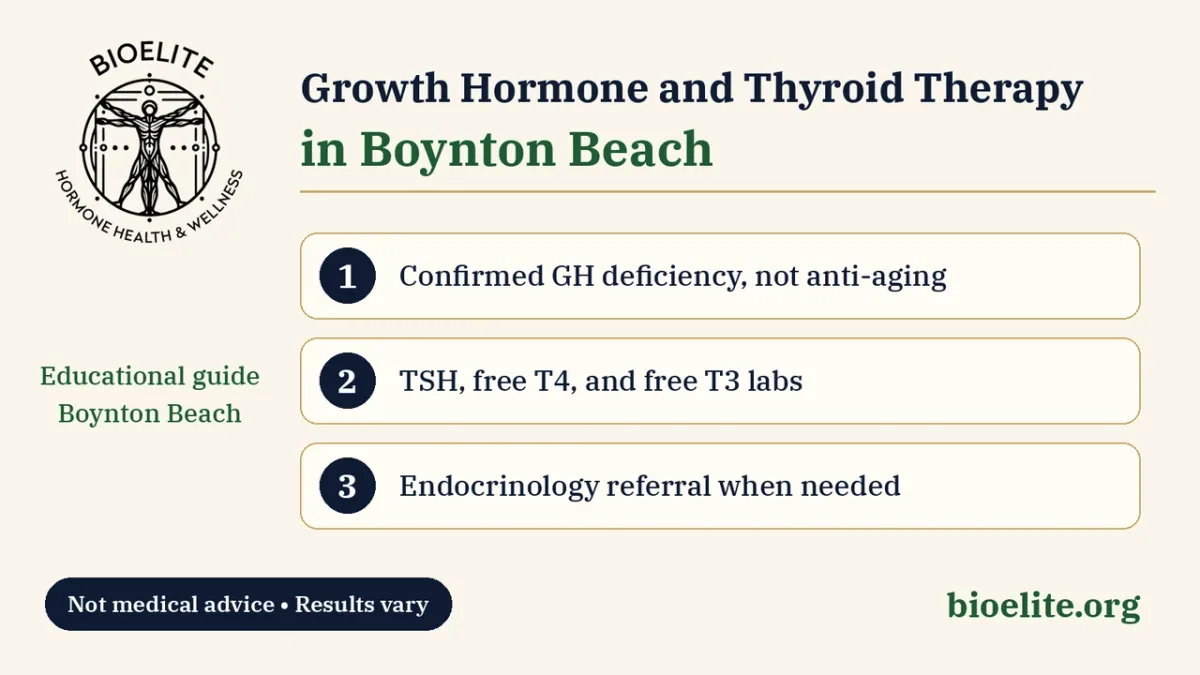
Growth Hormone and Thyroid Therapy in Boynton Beach
Educational content only. This article does not diagnose, treat, or prescribe, and it does not promise outcomes. Always discuss personal medical decisions with a licensed clinician. Individual results vary.
If you are searching for growth hormone therapy in Boynton Beach or thyroid hormone therapy in Boynton Beach, you are probably trying to sort out two different questions at once: what these hormones do, and who should be treating a problem with them. Both topics attract confusing marketing. Growth hormone is often described as an anti-aging shortcut, and thyroid symptoms are often attributed to hormone problems that testing may not confirm.
This guide gives an honest explanation of both. It covers when growth hormone therapy is medically indicated, how thyroid labs such as TSH, free T4, and free T3 are read, why thyroid care is typically led by endocrinology or primary care, and how a supervised evaluation at BIOELITE Hormone Health and Wellness in Boynton Beach coordinates or refers when another specialist is the right fit. It does not recommend doses, products, or protocols, and it makes no promises about outcomes.
Why growth hormone and thyroid questions often appear together
Both growth hormone and thyroid hormone are part of the endocrine system, the network of glands that sends hormone signals through the body. Low energy, changes in body weight, mood shifts, and slower recovery can show up with several hormone problems, and with many problems that are not hormonal at all. That overlap is the reason a careful evaluation looks at the whole picture rather than assuming one hormone is the cause.
BIOELITE is located at 1101 N. Congress Ave, Suite 100, Boynton Beach, FL 33426, and serves patients from Boynton Beach and nearby Palm Beach County communities. Our broader hormone replacement therapy page describes the hormone-focused evaluation process.
Growth hormone therapy: when it is medically indicated
Growth hormone (GH) is made by the pituitary gland. Prescription GH medicines, known as somatropin products, are FDA-approved for specific conditions. These include growth failure in children from several causes, confirmed growth hormone deficiency in adults, and a small number of other defined conditions. Approval applies to the diagnosis listed on the label.
For adults, the key phrase is confirmed deficiency. Adult growth hormone deficiency is uncommon. It most often occurs in people with a known pituitary problem, such as a tumor, surgery, radiation, or other pituitary or hypothalamic disease, or with childhood-onset deficiency that continues into adulthood. Endocrine Society guidance emphasizes careful testing before treatment is considered.
How growth hormone deficiency is confirmed
Symptoms alone cannot confirm growth hormone deficiency. Fatigue, weight changes, and lower exercise tolerance are common and nonspecific. A blood marker called IGF-1 is often checked, but a single IGF-1 number is not enough to make the diagnosis by itself. IGF-1 can be affected by age, liver disease, nutrition, diabetes, and thyroid status. When deficiency is genuinely suspected, endocrinologists typically use a stimulation test, which measures how the pituitary responds to a trigger, along with a review of pituitary history and other pituitary hormones.
This is specialist territory. A hormone clinic can help organize your history and labs, but confirmation of adult growth hormone deficiency belongs with endocrinology.
What growth hormone therapy is not
Growth hormone is not FDA-approved for anti-aging, general wellness, or athletic performance, and federal law restricts distribution of GH for those purposes. Using it without a confirmed medical indication carries known risks, including fluid retention, joint pain, and effects on blood sugar. Online ads that promise youth, fat loss, or muscle gain from "HGH" should be treated with skepticism, and the same goes for products sold as "HGH boosters."
Some people are also curious about peptides that signal the pituitary rather than replace growth hormone directly. Those have a separate and still-evolving regulatory story. Our guides on sermorelin and growth hormone peptide literacy explain why approval status and evidence must be checked product by product, and our peptide therapy guide for Boynton Beach covers the FDA-approved, compounded, and research-only distinctions.
Thyroid basics: what the thyroid does
The thyroid is a small gland in the neck that produces hormones influencing metabolism, heart rate, body temperature, and energy. Too little thyroid hormone is called hypothyroidism, and too much is called hyperthyroidism. Both are common medical conditions with established diagnostic and treatment pathways. Many symptoms, including tiredness, weight changes, hair changes, and mood shifts, overlap with other causes, so lab testing matters.
Thyroid labs explained: TSH, free T4, and free T3
TSH (thyroid-stimulating hormone) comes from the pituitary and tells the thyroid how much hormone to make. It is often the first test ordered. Free T4 measures the main thyroid hormone circulating in the blood that is available to tissues. Free T3 measures the more active form of thyroid hormone. Some clinicians also check thyroid antibodies, such as TPO antibodies, when an autoimmune thyroid condition is suspected.
Results are read together, not as isolated numbers, and in the context of symptoms, medications, pregnancy status, and other conditions. Our related literacy posts on thyroid labs, TSH, and free T4 and free T3 and thyroid antibodies go deeper. This article does not tell you what any specific result means for you.
Who typically leads thyroid treatment
Thyroid disease is usually managed by a primary care clinician or an endocrinologist. Hypothyroidism is commonly treated with prescription thyroid hormone replacement, and hyperthyroidism may involve medicines, other therapies, or procedures chosen by a specialist. Treatment requires follow-up lab monitoring to confirm that the plan is working safely. Dose decisions are individual and are not covered here.
When to see an endocrinologist
Consider asking your primary care clinician for an endocrinology referral, or seeking one directly, when any of the following apply:
Thyroid labs are persistently abnormal or results are hard to interpret.
A lump, nodule, or enlarged thyroid is noticed, or you have neck swelling.
You are pregnant, planning pregnancy, or recently postpartum with thyroid concerns.
There is a history of pituitary disease, head injury, brain surgery, or radiation.
Heart rhythm changes, rapid weight change, or severe symptoms accompany thyroid concerns.
Adult growth hormone deficiency is suspected and needs stimulation testing.
Seek urgent medical care for severe symptoms such as chest pain, fainting, or confusion. This is general education, and it is not a substitute for a clinician's advice.
How BIOELITE evaluates and coordinates
A hormone evaluation at BIOELITE begins with a Licensed Provider reviewing your symptoms, history, medications, and goals. Labs may include thyroid screening markers alongside other hormone and metabolic markers, depending on your situation. See our lab testing page and the guide to the complete hormone lab panel for how supervised labs are organized.
The evaluation considers other possible causes for symptoms, including sleep, stress, medications, and other hormone changes. When results suggest thyroid disease, a pituitary problem, or suspected growth hormone deficiency, the appropriate next step is typically coordination with, or referral to, your primary care clinician or an endocrinologist who can confirm the diagnosis and manage treatment. BIOELITE does not present thyroid disease treatment or growth hormone replacement as services in this article.
Does BIOELITE prescribe growth hormone for anti-aging?
No. Educational content on this site does not support anti-aging claims for growth hormone, and this article does not describe it as an option for that purpose. Evaluation focuses on identifying what is going on and routing you to the right type of care.
Can thyroid symptoms be checked without seeing an endocrinologist first?
Often yes. Baseline thyroid labs are routine and many primary care clinicians and hormone-focused clinics order them. If labs are abnormal, or the picture is complex, an endocrinologist is the usual next step. Bring any prior results with dates so the clinician can compare trends.
Telehealth and in-person visits
In-person visits at the Boynton Beach office are by appointment only, Monday through Friday, 9 AM to 5 PM. Walk-ins are not available. Telehealth video visits are available until 8 PM in states where our providers are licensed, and all states will be available soon. Eligibility and licensure rules always apply, and messages are answered 24 hours a day. For office logistics, see our Boynton Beach hormone therapy guide.
Practical next steps
Write down your symptoms, when they started, and what has already been tried.
Gather prior thyroid labs, IGF-1 results, and imaging or pituitary history, with dates.
List all medications and supplements, including biotin, which can affect some lab results.
Prepare questions about which labs are appropriate and when a referral makes sense.
Choose an in-person Boynton Beach visit or an eligible telehealth visit.
Call (561) 821-3005 or use our contact page to schedule. Common process questions are answered on our FAQ. Nearby communities are covered on our Palm Beach County page, and our guide to testosterone therapy in Boynton Beach covers a related hormone evaluation path for men.
Medical disclaimer: This article is for general education only and is not medical advice. It does not diagnose growth hormone deficiency, thyroid disease, or any other condition; it does not recommend doses, products, or self-directed protocols; and it does not instruct you to start, stop, or change any medication or supplement. Regulatory and clinical summaries reflect publicly available FDA and Endocrine Society patient-education information as of October 2026 and may change. Evaluation and any testing or treatment decisions require a licensed clinician. Individual results vary. Availability of in-person and telehealth care depends on clinical eligibility and applicable licensure. Visit hours may change; please confirm when scheduling.
