
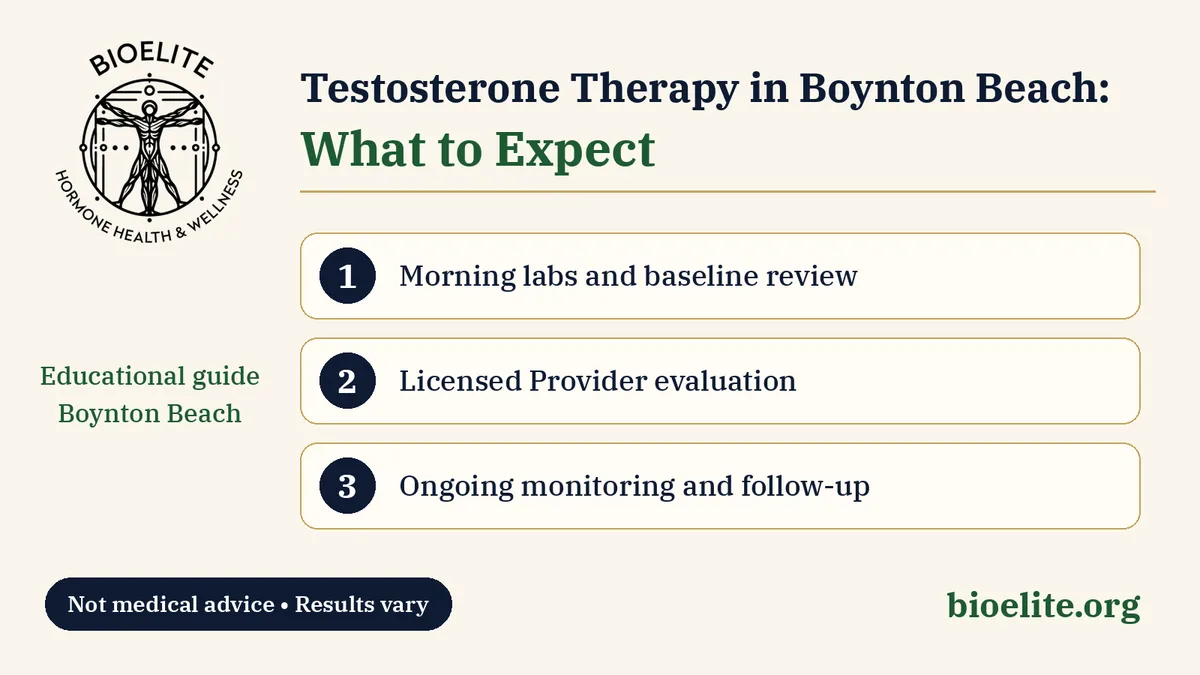
Testosterone Therapy in Boynton Beach: What to Expect
Educational content only. This article does not diagnose, treat, or prescribe, and it does not promise outcomes. Always discuss personal medical decisions with a licensed clinician. Individual results vary.
If you are searching for testosterone therapy in Boynton Beach, or for TRT Boynton Beach options, you are usually looking for a clear picture of what evaluation involves, not a product pitch. Low energy, lower sex drive, mood changes, and muscle loss can have many causes. Some men also search for andropause treatment or low testosterone treatment near Boynton Beach when those symptoms show up in midlife.
This guide explains what to expect from a supervised testosterone evaluation at BIOELITE Hormone Health and Wellness in Boynton Beach: which labs usually come first, how a Licensed Provider puts symptoms and numbers together, what "stimulation-first" literacy means before replacement is discussed, and how monitoring works if testosterone therapy becomes part of a plan. It is educational only. Care decisions belong in a supervised visit.
For office location, appointment hours, and a broader hormone-care logistics overview, see our local hormone therapy guide. This article focuses on the testosterone and TRT evaluation path for men.
What testosterone therapy searches in Boynton Beach usually mean
Local searches such as testosterone therapy Boynton Beach, testosterone replacement therapy Boynton Beach, and TRT clinic Boynton Beach often mix three different questions: Do I have low testosterone? What does a proper evaluation look like? And if treatment is appropriate, what should I expect afterward?
BIOELITE is based at 1101 N. Congress Ave, Suite 100, Boynton Beach, FL 33426, and serves men from Boynton Beach and nearby Palm Beach County communities. Our testosterone therapy page describes an evaluation-first approach. Nearby city guides for Boca Raton and Delray Beach cover choosing a clinic in those markets; this post is specifically about the Boynton Beach evaluation pathway.
Not every man who asks about TRT needs it. Sleep apnea, stress, medications, metabolic issues, and other medical conditions can look similar. A careful clinic starts with history, compatible symptoms, and confirmed labs, not with a one-size protocol.
Symptoms men often ask about, and common look-alikes
Men considering low testosterone treatment in Boynton Beach commonly describe lower libido, erectile changes, fatigue, reduced motivation, mood shifts, loss of muscle or strength, increased body fat, or thinner body hair. The Endocrine Society's patient education on male hypogonadism notes that low testosterone plus compatible symptoms define the clinical picture, and that signs and symptoms vary from person to person.
Those symptoms are not specific to testosterone deficiency. Similar complaints can appear with poor sleep, depression, obesity, thyroid disease managed elsewhere, medication effects, or overtraining. This article does not diagnose anyone. The point of listing symptoms is to show why a Licensed Provider looks at the whole picture before discussing testosterone therapy.
Our related guide on andropause vs low testosterone explains why the word "andropause" can confuse searches for andropause treatment Boynton Beach FL, and what clinicians usually mean instead.
Labs that usually come before any TRT discussion
Major guidelines emphasize confirmation, not a single afternoon blood draw. The American Urological Association (AUA) guideline on testosterone deficiency states that the diagnosis of low testosterone should be made only after two total testosterone measurements, both conducted in an early morning fashion, together with symptoms or signs. MedlinePlus similarly notes that the best time for a testosterone blood sample is often between about 7 a.m. and 10 a.m., and that a second sample is often needed to confirm a lower-than-expected result.
A Licensed Provider may also order related tests to understand free versus total testosterone, binding proteins such as SHBG, pituitary signals (LH and FSH), estradiol, prolactin, blood counts, metabolic markers, or prostate-related labs such as PSA when appropriate for age and history. Related educational posts on the complete hormone lab panel, free vs total testosterone, and how to prepare for hormone bloodwork explain those pieces without turning results into a DIY diagnosis.
BIOELITE currently uses Quest Diagnostics for ordered lab draws. Patients may also use LabCorp. Confirm the collection location and any appointment details with the lab before you go. Do not stop any medication for a lab test unless your clinician tells you to. See our lab testing page for how supervised labs support evaluation.
Stimulation-first literacy: supporting your own production vs replacement
Before any discussion of testosterone replacement, it helps to understand two different ideas. Supporting the body's own testosterone production (sometimes called stimulation) aims to help the hormone system make more of its own testosterone when that is clinically appropriate. Testosterone replacement supplies testosterone from outside the body when deficiency is confirmed and the expected benefits and risks support that path.
BIOELITE's approach prioritizes evaluating whether the body's own production can be supported medically before considering replacement. That does not mean every man can stimulate production, and it does not mean stimulation options are "natural supplements" free of medication risks. Fit depends on the cause of low levels, fertility goals, other medical conditions, and clinical judgment. Some options discussed in medical education are used off-label; ask about approval status, evidence, side effects, and monitoring for any specific medicine under consideration.
Our article on hormone stimulation versus replacement and the guide on how to qualify for testosterone replacement therapy add more literacy. This Boynton Beach guide does not recommend doses, products, or self-directed protocols, and BIOELITE does not present pellets, IV therapy, or thyroid care as services here.
What a Licensed Provider evaluation usually covers
Whether you meet in the Boynton Beach office or by video when eligible, a first testosterone evaluation generally includes:
Your story. Symptoms, timeline, goals, sexual health concerns, fertility plans, sleep, exercise, and stress.
Health history. Conditions, surgeries, medications and supplements, prior hormone treatment, and family history that may matter for prostate or cardiovascular risk discussions.
Lab review. Confirmed morning testosterone results and any related markers the clinician ordered or that you already have with dates.
Context and look-alikes. Whether other issues could explain the picture better than testosterone alone.
Options and next steps. Lifestyle factors, further testing, referral when needed, monitoring alone, stimulation-oriented approaches when appropriate, or a discussion of testosterone replacement risks and benefits when clinically suitable and permitted.
A first visit is a starting point for an informed decision. It is not a commitment to any treatment. For a step-by-step look at video visits, see how online telehealth TRT evaluation works.
Monitoring if testosterone therapy becomes part of a plan
If a Licensed Provider and patient decide that testosterone therapy is appropriate after evaluation, follow-up and lab monitoring are part of responsible care. Educational summaries from the AUA guideline and Endocrine Society materials discuss checking testosterone levels after treatment starts, watching hematocrit (blood thickness), and considering PSA and prostate-related follow-up in men when age and history call for it. Blood pressure monitoring has also received renewed attention in FDA labeling updates for testosterone products.
Exact schedules and thresholds are clinical decisions. This article does not list dosing protocols or monitoring tables. The takeaway for Boynton Beach patients is simple: supervised care includes planned check-ins and labs, not a one-time prescription without follow-up. Related posts on hematocrit monitoring on TRT and PSA monitoring on TRT provide more educational detail.
Soft telehealth notes for eligible patients
Men researching a TRT clinic in Boynton Beach sometimes want an in-person visit first; others prefer video follow-ups after labs. Telehealth video visits are available until 8 PM in states where our providers are licensed, and all states will be available soon. Soft eligibility and licensure rules always apply. Messages are answered 24 hours a day.
In-person visits at the Boynton Beach office are by appointment only, Monday through Friday, 9 AM to 5 PM. Walk-ins are not available. Full logistics (address, hours, lab handling, first-visit overview) live in the Boynton Beach hormone therapy guide linked above, so this TRT-focused article does not repeat that local guide.
Practical next steps
Write down your main symptoms, when they started, and what has already been tried.
List medications, supplements, sleep issues, and any fertility goals.
Gather recent morning testosterone labs with dates and times drawn, if you have them.
Decide whether an in-person Boynton Beach visit or an eligible telehealth visit fits better.
Bring questions about stimulation versus replacement, monitoring, and which labs will be reviewed.
Call (561) 821-3005 or use our contact page to schedule. Process questions are on our FAQ. Fee overview sits on our pricing page. Nearby communities are covered on our Palm Beach County page. Sibling city posts such as TRT clinic Boca Raton and TRT Delray Beach remain useful for those markets; Boynton Beach men can start here.
Medical disclaimer: This article is for general education only and is not medical advice. It does not diagnose low testosterone, andropause, or any other condition; it does not recommend doses, products, or self-directed protocols; and it does not instruct you to start, stop, or change any medication or supplement. Guideline and regulatory summaries reflect publicly available AUA, Endocrine Society patient-education, MedlinePlus, and FDA materials as of October 2026 and may change. Evaluation and any testing or treatment decisions require a licensed clinician. Individual results vary. Availability of in-person and telehealth care depends on clinical eligibility and applicable licensure. Visit hours may change; please confirm when scheduling.
