
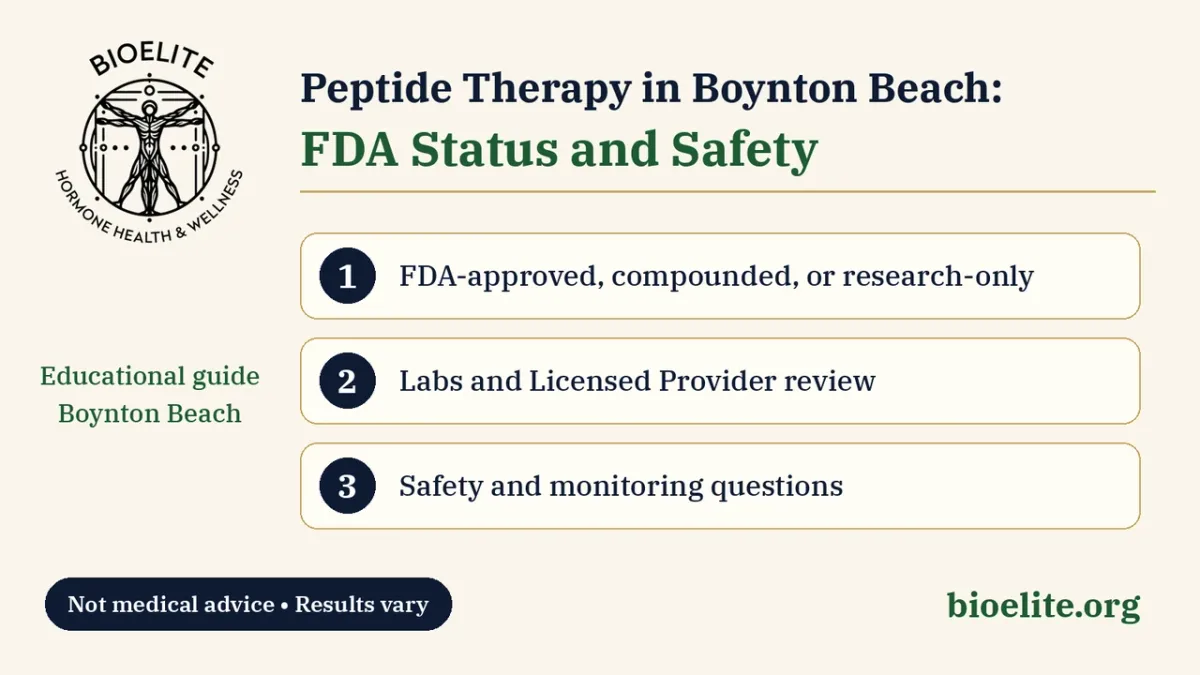
Peptide Therapy in Boynton Beach: FDA Status and Safety
Educational content only. This article does not diagnose, treat, or prescribe, and it does not promise outcomes. Always discuss personal medical decisions with a licensed clinician. Individual results vary.
If you are searching for peptide therapy in Boynton Beach, or for peptide therapy near me, you have probably noticed how different the answers look. Some pages describe approved prescription medicines. Others describe compounded products, and some websites sell vials labeled for research only. These categories are not interchangeable, and the differences matter for safety.
This guide is a regulatory-literacy overview, not a product list. It explains what peptides are, how FDA-approved, compounded, and research-only products differ, where the evidence is strong and where it is thin, and what a supervised evaluation at BIOELITE Hormone Health and Wellness in Boynton Beach usually involves. It does not recommend doses, protocols, or specific products, and it does not predict results.
For a broader look at choosing a clinic, see our article on peptide therapy near me. This post focuses on Boynton Beach and on how to read the regulatory landscape.
What people mean by peptide therapy in Boynton Beach
"Peptide therapy" is a marketing phrase more than a medical diagnosis. Local searches often bundle several unrelated ideas: hormone-axis medicines, weight management medicines, recovery products, and anti-aging claims. A careful clinic separates those questions and asks first what a patient is trying to address, and whether a peptide is even the right tool.
BIOELITE is located at 1101 N. Congress Ave, Suite 100, Boynton Beach, FL 33426, and serves patients from Boynton Beach and nearby Palm Beach County communities. Our peptide therapy service page explains how evaluation works.
What peptides are, in plain language
Peptides are short chains of amino acids, the building blocks of proteins. The body makes many of them naturally, and several act as hormones or signaling molecules. Insulin, oxytocin, and the hormones that signal the pituitary gland are familiar examples.
That biology explains why peptides are interesting to medicine. It does not mean that every peptide sold online has been shown to be safe or effective. Each peptide has its own intended use, its own evidence, and its own risks. Treating "peptides" as one category is the first mistake many readers make.
FDA-approved, compounded, or research-only: three different buckets
FDA-approved peptide medicines. Some peptide drugs have gone through FDA review for specific uses, with manufacturing standards and labeling. Examples include semaglutide and tirzepatide (approved for specific uses such as type 2 diabetes or chronic weight management), teriparatide (osteoporosis), and tesamorelin (reduction of excess abdominal fat in adults with HIV and lipodystrophy). Approval applies to a defined use in a defined population.
Compounded peptide preparations. A compounded drug is prepared by a pharmacy for an individual patient on a prescription. Compounded drugs are not FDA-approved, and FDA does not review them for safety, effectiveness, or quality before they are dispensed. Federal law allows compounding within limits, and the rules about which ingredients may be compounded are specific. FDA maintains interim category lists for bulk drug substances, and during 2026 the agency changed the placement of several peptides on those lists and convened an advisory committee to review some of them. Placement on a list is a compounding-policy decision. It is not an approval, and it can change again.
Research-only products. Many websites sell peptides labeled "for research use only" or "not for human consumption." These products are intended for laboratory work, not for patients. They may have no clinical-grade quality controls, no sterility testing, and no oversight of purity or strength. FDA has issued warning letters to sellers whose marketing showed human-use intent despite a research label. A research label is a reason for caution, not a loophole, and clinicians who follow responsible standards do not treat research-only material as a medicine.
One example of how status can be confusing: sermorelin. The original brand-name product was discontinued by its manufacturer, and FDA has said that decision was not based on safety or effectiveness concerns, but no sermorelin product is currently FDA-approved. Our guide to sermorelin and the related article on growth hormone peptide literacy explain why wording such as "FDA-approved" should always be checked against the specific product.
What the evidence does and does not show
Evidence varies widely. For some approved peptide medicines, large clinical trials support specific uses and specific safety warnings. For many other peptides marketed for recovery, longevity, sleep, or performance, the published evidence is mostly laboratory or animal research, small studies, or case reports.
Practical points for readers:
Animal or cell research does not establish benefit in people.
Testimonials and photo comparisons are not evidence.
Long-term safety data are limited or absent for many peptides sold outside approved uses.
A product being easy to buy online does not mean it is appropriate for you.
The same caution applies to NAD+, which is a coenzyme rather than a peptide, but is often marketed in the same space. Our NAD+ evidence and FDA status guide covers that topic separately.
What a peptide evaluation involves
A responsible evaluation starts with your story, not a product. At BIOELITE, a Licensed Provider reviews your symptoms and goals, medical history, current medications and supplements, prior treatments, and any concerns about pregnancy plans, cancer history, diabetes, or heart health. The provider may order labs to understand your overall hormone and metabolic picture, depending on the question. Related literacy articles on the complete hormone lab panel and how to prepare for hormone bloodwork describe common starting points. Our lab testing page explains how supervised labs fit in.
The evaluation also considers other possible causes for what you are experiencing. Poor sleep, thyroid or other hormone issues, medication effects, stress, nutrition, and metabolic conditions can all explain fatigue, slow recovery, or changes in body composition. Sometimes the right next step is further testing, a referral, or lifestyle changes rather than any peptide at all. A visit is the start of an informed conversation about options and their risks, benefits, and approval status.
Is peptide therapy FDA approved?
It depends on the peptide and the use. Some peptide medicines are FDA-approved for specific conditions. Many peptides promoted online are not approved for any use, and others are approved for a purpose different from the one being advertised. When a clinic or website says a peptide is "FDA-approved," ask which product, for which condition, and whether the product being offered to you is the approved drug or a compounded preparation.
Are compounded peptides the same as FDA-approved drugs?
No. Compounded preparations are made by a pharmacy for an individual patient and are not reviewed by FDA for safety, effectiveness, or quality before use. Ask who compounds the product, whether the pharmacy is state-licensed and appropriately registered, and why a compounded version is being considered when an approved option exists.
Can I buy peptides labeled for research and use them safely?
This article does not recommend self-directed use of any product. Research-only material is not made or tested for human use, and the labeled contents may not match what is in the vial. If you have already used a peptide or supplement, tell your clinician. Honest disclosure helps a provider interpret labs safely.
Safety and monitoring questions to discuss
Any peptide treatment decided on after evaluation belongs in a supervised plan with follow-up. Topics a clinician may discuss include known side effects, possible interactions with other medicines, injection-site reactions, allergic or immune reactions, effects on blood sugar, heart rate or blood pressure, and which symptoms should prompt you to call right away. Monitoring may include periodic visits and labs when appropriate. Exact schedules are clinical decisions, and this article does not list protocols.
Warning signs worth taking seriously: a seller who promises specific results, avoids naming the product source, discourages you from telling your regular doctor, or offers shipment without any evaluation. Our guide to telehealth hormone clinic red flags covers more of these patterns.
Telehealth and in-person visits
In-person visits at the Boynton Beach office are by appointment only, Monday through Friday, 9 AM to 5 PM. Walk-ins are not available. Telehealth video visits are available until 8 PM in states where our providers are licensed, and all states will be available soon. Eligibility and licensure rules always apply, and messages are answered 24 hours a day. For office logistics and a first-visit overview, see our Boynton Beach hormone therapy guide.
Practical next steps
Write down the specific symptoms or goals that led you to search for peptide therapy.
List current medications, supplements, and any peptides or injectables you have used.
Gather recent lab results with dates, if you have them.
Prepare questions about approval status, evidence, who prepares the product, side effects, and monitoring.
Decide whether an in-person Boynton Beach visit or an eligible telehealth visit fits your schedule better.
Call (561) 821-3005 or use our contact page to schedule. Common process questions are answered on our FAQ. Men and women looking for local hormone care can also review our Palm Beach County page and our guide to testosterone therapy in Boynton Beach.
Medical disclaimer: This article is for general education only and is not medical advice. It does not diagnose any condition; it does not recommend doses, products, or self-directed protocols; and it does not instruct you to start, stop, or change any medication or supplement. Regulatory summaries reflect publicly available FDA information as of October 2026. FDA policies on compounding and on specific peptides have changed recently and may change again, so please confirm current status with a licensed clinician and the FDA website. Evaluation and any testing or treatment decisions require a licensed clinician. Individual results vary. Availability of in-person and telehealth care depends on clinical eligibility and applicable licensure. Visit hours may change; please confirm when scheduling.
