NAD+ Therapy: What the Evidence and FDA Status Show
Educational content only. This article does not diagnose, treat, or prescribe, and it does not promise outcomes. Always discuss personal medical decisions with a licensed clinician. Individual results vary.
NAD+ is everywhere right now. It shows up on wellness clinic menus, in drip-bar ads, on supplement shelves, and in social media videos that promise more energy, sharper focus, or a younger body. Behind the marketing is a real and important molecule, and a body of research that is interesting but still early in people.
This guide explains what NAD+ is, why it is not a peptide or a hormone, what human research can and cannot show so far, how the FDA currently treats NAD+ products, and which questions are worth bringing to a Licensed Provider before you spend money or time on any NAD+ product. It is written for readers across the United States, with local context for people in Boynton Beach, Palm Beach County, and South Florida, where NAD+ is widely advertised.
What NAD+ is
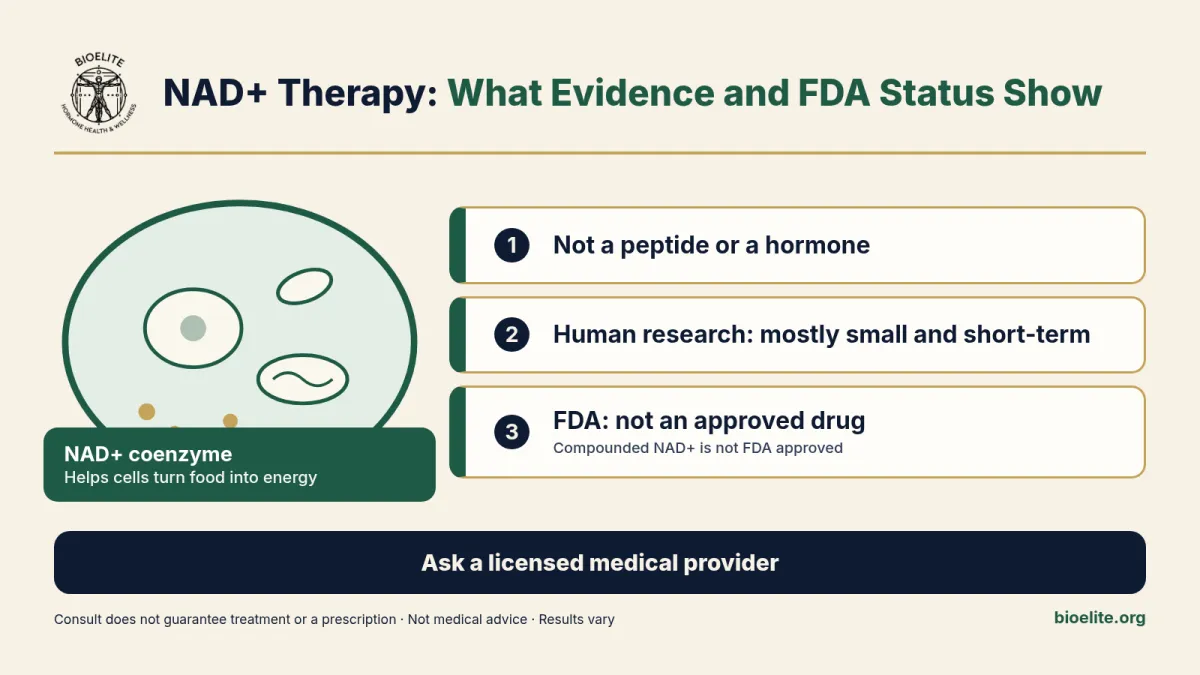
NAD+ stands for nicotinamide adenine dinucleotide. It is a coenzyme, a helper molecule found in every living cell. Its most familiar job is helping enzymes move electrons during the chemical reactions that turn food into usable cellular energy. NAD+ and its partner form, NADH, cycle back and forth as those reactions run.
NAD+ also serves as a raw material for other enzyme families that researchers study closely, including enzymes involved in DNA repair and a group often called sirtuins, which are linked to how cells respond to stress. That wide range of roles is a big reason scientists are interested in it.
Your body makes NAD+ on its own. It builds NAD+ from several starting materials found in food, including forms of vitamin B3 (niacin and nicotinamide) and the amino acid tryptophan. The NIH Office of Dietary Supplements notes that the body converts niacin into NAD, which is one reason a varied diet with adequate B vitamins matters.
Is NAD+ a peptide?
No. Many people search for "NAD+ peptide" because NAD+ is often offered alongside peptides at wellness and longevity clinics. Chemically, though, a peptide is a short chain of amino acids. NAD+ is a dinucleotide, built from two nucleotide units. It is also not a hormone. Grouping it with peptides is a marketing and menu convention, not a scientific category.
That distinction matters because each treatment has its own evidence, risks, and regulatory status. Our guide to ipamorelin and CJC-1295 peptide literacy explains a similar point for growth hormone peptides: the label on a menu does not tell you what the evidence shows.
Why NAD+ gets so much attention
Studies in cells and animals have reported that NAD+ levels can fall with age in some tissues, and that raising NAD+ in animal models can change certain markers of metabolism and cell function. Those findings sparked strong interest in whether boosting NAD+ might help people.
The jump from lab findings to human benefits is where caution is needed. Results in mice or cell cultures often do not carry over to people in the same way. Human biology, the amounts used, timelines, and measured outcomes are different. When an ad presents early laboratory research as if it shows an effect in people, it is getting ahead of the evidence.
What human research does and does not show
What researchers have looked at
Human studies have mainly tested NAD+ precursors, the building blocks the body can turn into NAD+, rather than NAD+ itself. Researchers have looked at whether these compounds raise NAD+-related markers in the blood and whether they affect measures such as blood pressure, muscle function, insulin sensitivity, or inflammation markers. Fewer studies have examined NAD+ given directly by injection or infusion, and those have generally been small.
Where the evidence is limited
Most human studies so far have been small, short-term, and done in specific groups, so the results may not apply broadly.
Showing that a compound raises a blood marker is not the same as showing that people feel better, live longer, or avoid disease.
Findings on functional outcomes such as energy, fitness, or thinking have been mixed or modest, and many important questions have not been tested well.
Long-term safety data in people are limited, especially for higher amounts and for products given outside a research setting.
Products sold to the public can differ from the materials used in studies.
In plain terms: NAD+ biology is a legitimate area of science, and research is active. But there is not yet consistent, high-quality evidence that NAD+ products slow aging, restore youthful energy, or treat a specific disease in people. Any honest discussion should say that clearly.
NAD+ regulatory status in the US
Regulatory status is one of the most misunderstood parts of the NAD+ conversation, and it can change. Here is what can be stated as of this writing.
NAD+ is not an FDA-approved drug
NAD+ is not an FDA-approved drug for aging, energy, or any other use. When a clinic offers NAD+ as an injection or infusion, it is generally a compounded preparation made by a pharmacy. The FDA states that compounded drugs are not FDA-approved and that the agency does not review them for safety, effectiveness, or quality before they are marketed.
NAD+ and the FDA compounding lists
The FDA keeps a public list of bulk substances that have been nominated for use in pharmacy compounding. In the FDA's May 2026 update of that list, nicotinamide adenine dinucleotide (NAD) appears in "Category 1," which the FDA describes as substances still under evaluation. Category 1 is not FDA approval. It reflects an interim FDA policy for compounding while the agency evaluates the substance, and that status can change if the FDA completes its review.
NAD+-related supplements
Some NAD+ precursors are sold as dietary supplements. The FDA does not review dietary supplements for safety and effectiveness before they reach the market. The status of these ingredients has also shifted: in 2022 the FDA said one precursor could not be sold as a supplement, and in September 2025 it reversed that position. That history is a good reminder to treat confident marketing claims about any NAD+ product with care.
Claims to be cautious about
When you see NAD+ advertised, these kinds of claims deserve extra skepticism:
That NAD+ reverses or stops aging, or makes you biologically younger.
That it guarantees more energy, focus, or stamina.
That it detoxes the body or cures a hangover, addiction, or chronic illness.
That it is FDA-approved, or that a compounded version is the same as an approved drug.
That it is risk-free because the body makes NAD+ naturally.
That a single lab test or "NAD+ level" tells you that you need it.
Our article on telehealth hormone clinic red flags covers more signs that a clinic is selling ahead of the evidence, such as skipping an evaluation or promising results.
Low energy or brain fog? Evaluation comes first
Many people look into NAD+ because they feel tired, foggy, or run down. Those symptoms are real, and they have many possible causes that can be evaluated with established tools. A clinician may consider:
Thyroid function. See our guide to thyroid labs in hormone evaluation.
Iron stores, vitamin D, and blood counts, covered in our guide to vitamin D and ferritin on a hormone panel.
Hormone changes such as low testosterone, perimenopause, or menopause.
Sleep quality, including possible sleep apnea.
Blood sugar, medications, mood, stress, and recent illness.
Our complete hormone lab panel guide shows how common labs fit together. Not every person needs every test, and a Licensed Provider decides what makes sense for you.
Safety topics to discuss with a clinician
Because the body makes NAD+ naturally, some people assume NAD+ products cannot cause problems. Any product that changes body chemistry deserves a careful review. Topics worth raising include:
Side effects reported with the specific product or format being proposed.
Pregnancy, breastfeeding, or plans to become pregnant, since data in these groups are limited.
Chronic conditions, including liver, kidney, or heart conditions, and any history of cancer.
Every medication and supplement you take. The NIH notes that niacin, one NAD+ building block, can cause skin flushing in high amounts and, when large amounts are taken over time, other problems such as liver effects.
Where a compounded product comes from and how its quality is checked.
Questions to ask a Licensed Provider
What do you think is behind my symptoms, and what should we rule out first?
What does the human evidence actually show for NAD+ in someone like me, and what is still unknown?
Is this product FDA-approved, compounded, or sold as a supplement, and what does that mean for quality and oversight?
Could it interact with my conditions, medications, or supplements?
How would we judge whether anything is helping, and when would we stop?
Are there established options for my concerns that should come first?
A careful clinic welcomes these questions and gives qualified, realistic answers. You can read more about supervised care and product oversight in our guide to peptide therapy near me.
How BIOELITE approaches NAD+ questions
BIOELITE Hormone Health and Wellness is based at 1101 N Congress Ave, Suite 100, Boynton Beach, FL 33426, in Palm Beach County. NAD+ is one of the related treatments patients can ask about on our peptide therapy page. Any discussion starts with a Licensed Provider evaluation of your symptoms, history, medications, and goals, and whether NAD+ is appropriate depends on that evaluation, clinical suitability, and applicable requirements. BIOELITE does not offer IV therapy.
Where labs help answer the underlying question, our lab testing page explains how lab work is handled. BIOELITE currently uses Quest Diagnostics for lab draws, with LabCorp also possible in some cases.
In-person visits at our Boynton Beach office are by appointment only, Monday through Friday, 9 AM to 5 PM. We do not take walk-ins.
Telehealth video visits are available until 8 PM.
Messages are answered 24 hours a day.
Telehealth care is available to patients in many parts of the United States, subject to clinical eligibility and applicable clinician licensure for the patient's location. For current fees, please see our pricing page. Hormone-related care is described on our hormone replacement therapy page, and answers to common process questions are on our FAQ page.
Practical next steps
Write down the symptoms that led you to NAD+, when they started, and what makes them better or worse.
Gather recent lab results, such as thyroid, iron, vitamin D, and hormone labs, with the dates they were drawn.
List every medication and supplement you take, including any NAD+ precursor or B-vitamin product.
If a clinic has offered you NAD+, note the exact product, its source, and what it claims to do.
Bring the questions above to a visit with a Licensed Provider, in person in Boynton Beach or by telehealth.
Have questions about NAD+, fatigue, or hormone health? Call (561) 821-3005 or reach us through our contact page. You can also explore more education on the BIOELITE home page.
Medical disclaimer: This article is for general education only and is not medical advice. It does not diagnose any condition; it does not recommend doses, products, routes of administration, or self-directed protocols; it does not claim that NAD+ or any related product slows aging, increases energy, or treats any disease; and it does not instruct you to start, stop, or change any medication or supplement. NAD+ is not an FDA-approved drug, and compounded preparations are not FDA-approved. Regulatory status described here reflects public FDA information as of October 2026 and may change. Evaluation and any testing or treatment decisions require a licensed clinician. A consultation does not guarantee treatment or a prescription. Individual results vary. Availability of in-person and telehealth care depends on clinical eligibility and applicable licensure. Fees may change; please confirm current amounts with BIOELITE before scheduling.
