
Perimenopause Support in Palm Beach County | BIOELITE
General health education, not medical advice. Individual results vary.
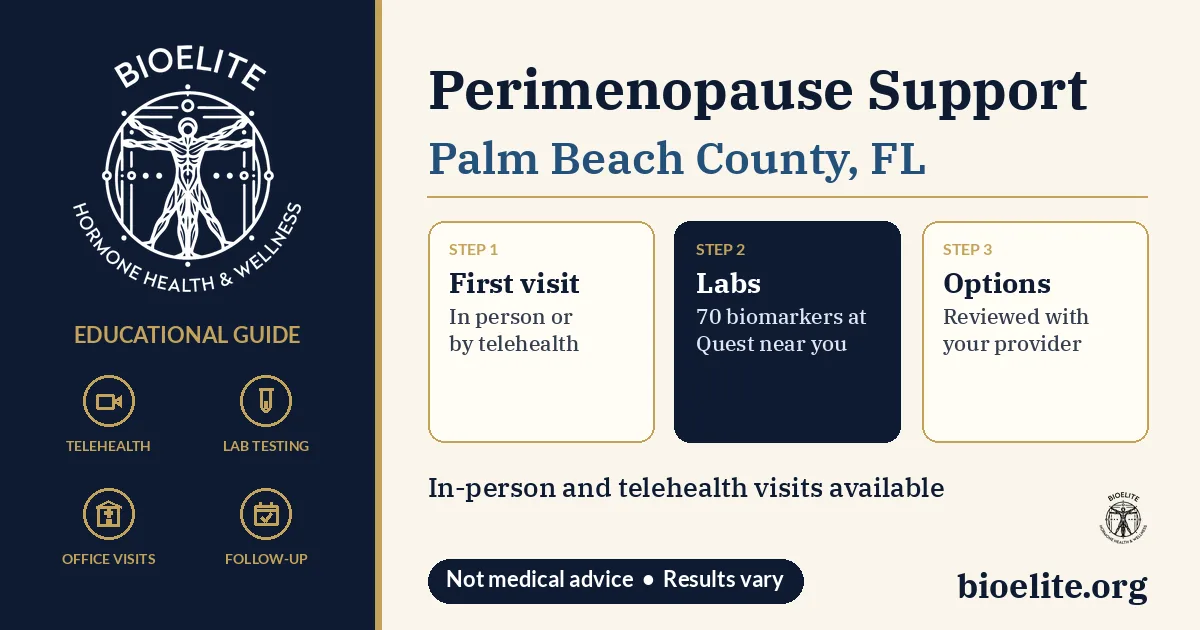
In brief: Perimenopause support starts with a clear picture of what is changing and why. At BIOELITE, that means a conversation with a Licensed Provider, in person or by telehealth, about your cycles, sleep, mood, and health history. Care includes a comprehensive blood test covering at least 70 biomarkers, done at a Quest location near you for convenience. From there, you and your provider weigh hormonal and non-hormonal options together, if and when they are clinically appropriate.
Clinical review: BIOELITE clinical team. Updated November 14, 2026.
Women across Palm Beach County, from Jupiter and Wellington to Boynton Beach and Boca Raton, often reach their 40s and notice that something has shifted. Periods come early, late, or heavier. Sleep gets lighter. Patience runs shorter than it used to. These changes are common, but common does not mean you have to simply wait them out. This guide explains what perimenopause is, which symptoms tend to show up, what lab work can and cannot tell you, and the options a Licensed Provider may review with you. For a deeper look at the evaluation itself, see our perimenopause hormone evaluation guide.
What perimenopause is, and why it can feel unpredictable
Perimenopause is the transition before menopause. During these years, the ovaries release estrogen and progesterone less evenly, so levels can be high one month and low the next. That variability explains why symptoms come and go, and why two women the same age can have very different experiences. The ACOG menopause years FAQ describes the transition as lasting, on average, several years before the final period.
Perimenopause symptoms women in Palm Beach County commonly report
No two transitions look alike, but these are the changes women most often bring to a first visit:
Cycle changes: shorter or longer cycles, skipped periods, or heavier bleeding
Hot flashes and night sweats, sometimes years before the final period
Sleep that is lighter or broken, even without night sweats
Mood changes, irritability, or anxiety that feels out of character
Brain fog and trouble concentrating
Vaginal dryness or discomfort, and changes in libido
Shifts in weight, especially around the middle, even without changes in diet
Many of these overlap with other conditions. Thyroid problems, low iron, sleep apnea, depression, and medication side effects can all look similar. That is why good perimenopause care starts with a careful history rather than a quick prescription. Heavy or prolonged bleeding, bleeding between periods, or bleeding after sex deserves prompt attention from your gynecologist or primary care clinician.
How perimenopause support works at BIOELITE
BIOELITE offers both in-person and telehealth visits, so you can choose the format that fits your week. Telehealth visits run seven days a week, 8 AM to 8 PM Eastern, in states where our Licensed Providers are licensed. In-person visits at the Boynton Beach office are by appointment, Monday through Friday, 9 AM to 5 PM.
A first visit with a Licensed Provider to talk through your symptoms, cycle history, medicines, and personal and family health history
A comprehensive blood test covering at least 70 biomarkers at a Quest location near you
A results review that puts the numbers in context with how you actually feel
A shared plan, which may include lifestyle changes, non-hormonal treatment, hormone therapy, or simply watching and rechecking
What to bring to your first visit
A few months of cycle dates (a phone app works well), a list of current medicines and supplements, notes on sleep and hot flashes, and any recent lab results. If you have had a mammogram, Pap test, or bone density scan, the dates are helpful too.
Perimenopause labs: what a comprehensive blood test can show
Care includes a comprehensive blood test covering at least 70 biomarkers, with more added when your health history calls for it. It is done at a Quest location near you for convenience, with about 2,000 locations nationwide. The panel includes testosterone, estradiol (estrogen), progesterone, and premium markers like IGF-1, along with thyroid markers such as TSH and vitamin D.
Here is the honest part: hormone levels in perimenopause can swing from week to week, so a single estradiol result does not diagnose or rule out the transition. Labs are most useful for spotting other explanations, such as an underactive thyroid or iron deficiency behind fatigue, and for setting a baseline before any therapy. Our complete hormone lab panel guide explains the markers in more detail, the thyroid labs guide covers TSH and free T4, and how to prepare for hormone bloodwork walks through the day of your draw. You can also read about our lab testing.
Perimenopause treatment options a Licensed Provider may discuss
The right approach depends on your symptoms, your health history, and what matters most to you. If clinically appropriate, options may include:
Lifestyle foundations: consistent sleep habits, regular strength training, limiting alcohol, and stress management, which can ease some symptoms on their own
Non-hormonal prescription options: several medicines can reduce hot flashes or help with sleep and mood for women who cannot or prefer not to use hormones
Hormonal birth control at a low dose: for some women in perimenopause, this can steady irregular cycles and ease symptoms
Estrogen with progesterone: estradiol as a patch, gel, spray, or pill, with progesterone added when the uterus is present to protect its lining
Vaginal estrogen at a low dose: for dryness or discomfort, with very little reaching the bloodstream
According to the FDA menopause page, FDA has approved hormone products that are chemically identical to the hormones the body makes. Many products marketed as bioidentical are compounded, and compounded products are not FDA-approved. A good provider will explain the difference plainly. For balanced information on benefits and risks, see MedlinePlus on hormone therapy for menopause and our estrogen and progesterone therapy for women guide.
Hormone therapy is not right for everyone. Your Licensed Provider will ask about any history of breast or uterine cancer, blood clots, stroke, heart disease, liver disease, or unexplained vaginal bleeding, since each can change which options fit. Any prescription comes only from your Licensed Provider, and only when it is medically appropriate. Our menopause treatment options guide compares hormonal and non-hormonal paths side by side.
Follow-up through the transition
Perimenopause is not a single decision. Symptoms change over time, so follow-up visits check how you are feeling, any side effects, and bleeding patterns, with repeat labs when they add something useful. Follow-up check-ins are done by telehealth. Keep your primary care clinician and gynecologist in the loop and stay current on routine screening, including mammograms; perimenopause care works alongside your regular medical care, not in place of it.
Choosing perimenopause care in Palm Beach County
Whatever clinic you choose, a few questions reveal a lot about how care actually works:
Who is my clinician? Ask for a name and license type you can verify.
What labs are included, and who explains them? Results should be reviewed with you, not just posted to a portal.
Are non-hormonal options on the table? A balanced plan includes them.
How are FDA-approved and compounded products explained? Clear answers are a good sign.
What does follow-up look like? Ask how often you will be seen and how dose changes are handled.
Our hormone provider review checklist has more questions, and the telehealth hormone clinic red flags guide covers warning signs to watch for online.
Related BIOELITE guides for women
For care closer to the office, read women's hormone care in Boynton Beach and bioidentical hormone therapy in Boynton Beach. Women in south county may also find bioidentical hormone therapy near Delray Beach and hormone therapy near Gulf Stream and Highland Beach useful. The hormone replacement therapy page gives an overview of our hormone care.
Take the next step
To book an in-person or telehealth visit with a Licensed Provider, call (561) 821-3005 or reach us through the BIOELITE contact page. Common questions are answered on our FAQ page, and our Palm Beach County hormone care page covers care across the county. The office is at 1101 N. Congress Avenue, Suite 100, Boynton Beach, FL 33426.
Perimenopause support FAQs
What is the difference between perimenopause and menopause?
Menopause is a single point in time: twelve months in a row without a period. Perimenopause is the transition leading up to it, when ovarian hormone levels rise and fall less predictably. It often begins in the 40s, sometimes earlier, and can last several years. Many of the symptoms women associate with menopause actually start during this stretch.
Can a blood test confirm perimenopause?
Usually not on its own. Hormone levels can change a great deal from week to week during the transition, so a single result rarely settles the question. Perimenopause is mostly recognized from your age, your cycle pattern, and your symptoms. A comprehensive blood test covering at least 70 biomarkers is included. The results inform your Licensed Provider's review by checking for other causes, such as thyroid changes, low iron, or blood sugar shifts, and by providing a baseline before any treatment is considered.
Is perimenopause support only about hormones?
No. Sleep, alcohol, stress, exercise, and other medicines all play a part, and some women prefer to start with non-hormonal approaches. Hormone therapy is one option among several, and it is considered only when it fits your history and goals.
Do I need to stop birth control before a perimenopause visit?
No. Keep taking any medicine as prescribed and bring the list to your visit. Hormonal birth control can mask cycle changes and affect some lab results, so your Licensed Provider will factor it in when reading your history and results.
Can I see a Licensed Provider by telehealth from anywhere in Palm Beach County?
Yes, as long as you are physically in a state where our Licensed Providers are licensed at the time of the visit. BIOELITE offers both in-person and telehealth visits, so you can choose whichever suits your schedule.
Where do I get my blood test?
At a Quest location near you, for convenience. Quest has about 2,000 locations nationwide. The comprehensive panel covers at least 70 biomarkers and includes testosterone, estradiol (estrogen), progesterone, and premium markers like IGF-1, along with thyroid markers such as TSH and vitamin D.
Who will I see?
A Licensed Provider. If you would like to confirm a Florida clinician's license before your visit, use the Florida Department of Health license lookup.
Medical disclaimer: This article is general health education for adults in Palm Beach County and beyond. It is not medical advice and should not be used to diagnose a condition or to start, stop, or change any medicine or hormone product. Treatment decisions are made by a licensed clinician who reviews your history and lab results together. Individual results vary. Care depends on clinical eligibility and licensure.