
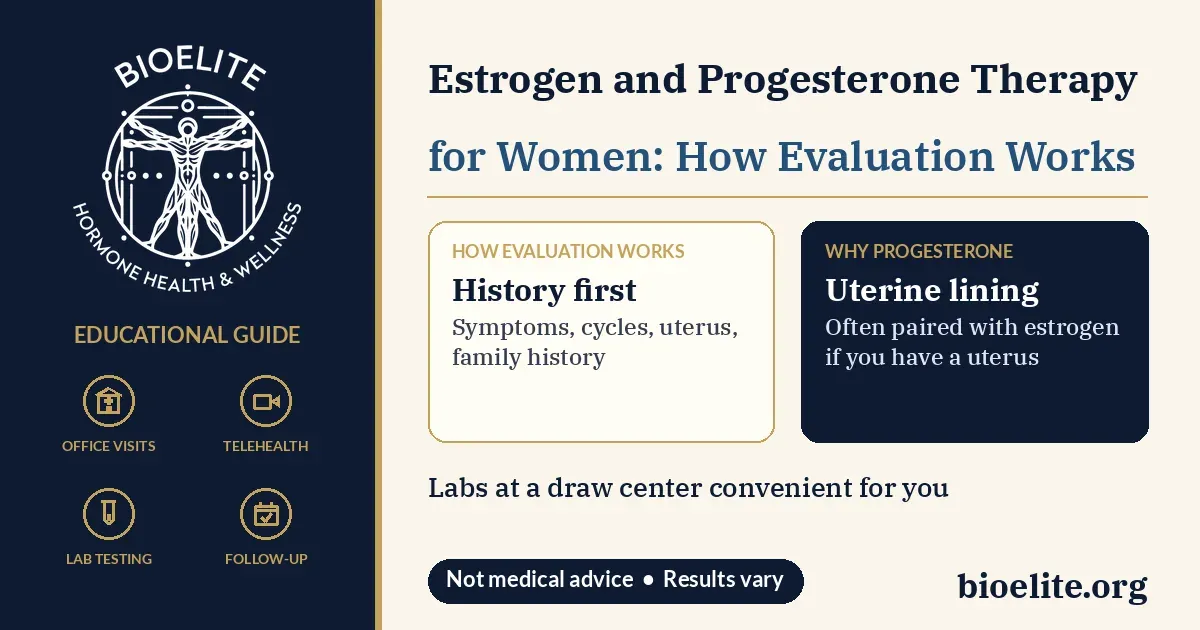
Estrogen and Progesterone Therapy for Women | BIOELITE
Educational content only. This article does not diagnose, treat, or prescribe, and it does not promise outcomes. Always discuss personal medical decisions with a licensed clinician. Individual results vary.
Quick answer: Estrogen and progesterone therapy for women usually starts with an evaluation, not a prescription. A Licensed Provider reviews your symptoms, cycle history, personal and family health history, and goals. Whether you still have a uterus shapes the plan, because women with a uterus who use estrogen are usually also given progesterone or a progestin. Labs may be ordered, with the blood draw at a draw center convenient for you.
Last updated: October 26, 2026. Reviewed by the BIOELITE clinical team.
Many women search for estrogen replacement therapy near me or progesterone near me when perimenopause or menopause symptoms start to affect sleep, mood, or daily life. This guide explains what estrogen and progesterone do, why they are usually discussed together, how an evaluation works at BIOELITE Hormone Health and Wellness in Boynton Beach, and what to ask before starting. For a walk-through of the visit itself, see our guide to menopause care in Boynton Beach.
What estrogen and progesterone do
The FDA explains on its menopause information page that during menopause a woman's body slowly produces less estrogen and progesterone, often between ages 45 and 55, and that menopause is reached after 12 months in a row without a period. Those changes may lead to symptoms such as hot flashes and vaginal dryness.
ACOG's The Menopause Years describes the ovaries as making estrogen, progesterone, and testosterone, and describes progestin as a synthetic form of progesterone. Some women also ask about testosterone; our article on low testosterone in women, symptoms and labs covers that question.
Why progesterone is part of the conversation
MedlinePlus explains that hormone therapy for menopause involves taking estrogen, with or without progesterone or a similar hormone called progestin. If you have had a hysterectomy, a provider may recommend estrogen-only therapy. If you still have your uterus, a provider may recommend estrogen plus progesterone or progestin.
The reason is the uterine lining. The FDA notes that for a woman with a uterus, estrogen increases the chance of endometrial cancer, which is cancer of the uterine lining, and that adding progestin lowers this risk. That is why one of the first questions in an evaluation is whether you still have a uterus.
Forms of estrogen, and the bioidentical question
ACOG describes systemic estrogen forms, including pills, skin patches, and gels and sprays applied to the skin, and local estrogen in the form of a vaginal ring, tablet, or cream that releases small doses of estrogen into the vaginal tissue. ACOG also notes that both systemic and local estrogen can relieve vaginal dryness. Which form, if any, may fit depends on your symptoms and history.
Some women ask specifically for bioidentical estradiol or progesterone. ACOG notes that bioidentical hormones include both commercially available products and compounded preparations. The FDA has approved hormone products identical to the hormones women make in their reproductive years, recommends that women use FDA-approved hormone therapies, and says it does not have evidence that compounded bioidentical hormones are safer or more effective. Our article on bioidentical hormone therapy for women and our comparison of bioidentical hormones and standard HRT go deeper.
How an estrogen and progesterone evaluation works
Every plan is individual, but an evaluation usually covers five areas.
1. Symptoms and cycle history
A Licensed Provider asks which symptoms bother you most, when your last period was, whether your cycles have changed, and whether you have had a hysterectomy or other gynecologic surgery. Our perimenopause hormone evaluation guide covers the years before periods stop.
2. Personal and family health history
Hormone therapy is not for everyone. The provider reviews personal and family history such as blood clots, stroke, heart attack, breast cancer, and gallbladder disease, any unexplained vaginal bleeding, and your current medicines and supplements. That history shapes whether estrogen may be considered at all.
3. Labs when they help
Menopause is usually recognized from age, symptoms, and cycle history, so labs are not always needed to start the conversation. When labs help, for example to look at other causes of symptoms or during follow-up, blood draws are not done at our office. You go to a draw center convenient for you; BIOELITE currently uses Quest. Our guide to estradiol labs for women explains what an estradiol result can and cannot show, and how to prepare for hormone bloodwork covers timing. See our lab testing page for how lab work is organized.
4. Reviewing options and risks
If hormone therapy may fit, the provider explains the options, such as estrogen-only or combined therapy and which form, along with the possible risks. The FDA lists possible risks for some women, including blood clots, heart attacks, strokes, breast cancer, and gallbladder disease. Non-hormonal approaches are part of the conversation too; see menopause treatment options, hormonal and non-hormonal. Our hormone replacement therapy page outlines how BIOELITE approaches care.
5. Follow-up
The FDA advises that women who decide to use hormone therapy use the lowest dose that helps, for the shortest time they need it. Follow-up visits review how symptoms are changing, any side effects or new bleeding, and repeat labs when useful, and a plan can be adjusted or stopped.
Questions to ask before starting estrogen or progesterone
Do I need progesterone or a progestin with estrogen, and why?
Is the product in my plan FDA-approved or compounded?
Which form fits my symptoms: pills, patches, gels, or vaginal estrogen?
Which risks apply to me, given my personal and family history?
How often will we review the plan, and when would we adjust or stop it?
The Menopause Society offers menopause patient education resources that can help you prepare, and our bioidentical hormone therapy patient guide answers common background questions.
Estrogen and progesterone care in Boynton Beach and by telehealth
Women looking for BHRT for women in Boynton Beach or nearby can visit our office at 1101 N. Congress Avenue, Suite 100, Boynton Beach, FL 33426, serving Palm Beach County and South Florida. In-person visits are by appointment only, Monday through Friday, 9 AM to 5 PM; we do not take walk-ins. You can find our Boynton Beach office on Google Maps, and our Boynton Beach hormone therapy guide covers local care more broadly.
Telehealth video visits are available seven days a week, 8 AM to 8 PM Eastern, for patients in states where our Licensed Providers are licensed. Many women use telehealth for symptom reviews, lab reviews, and follow-ups.
Practical next steps
New patients can book at our online booking page, call (561) 821-3005, or use our contact page. Common process questions are answered on our FAQ.
Existing clients can use our existing-client booking page.
Browse more in our Hormone Health Guides or see all health guides.
Frequently asked questions about estrogen and progesterone therapy
Do all women who use estrogen also need progesterone?
Not all. MedlinePlus explains that after a hysterectomy a provider may recommend estrogen-only therapy, while women who still have a uterus may be advised to use estrogen plus progesterone or a progestin. The FDA notes that adding progestin lowers the higher risk of uterine-lining cancer that estrogen alone carries for a woman with a uterus. Your Licensed Provider explains what applies to you.
Is progesterone the same as progestin?
Not exactly. ACOG describes progestin as a synthetic form of progesterone that is similar to the hormone the body makes. A Licensed Provider can explain which one a plan uses and why.
Do I need blood work before estrogen therapy?
Not always. Menopause is usually recognized from age, symptoms, and cycle history. Labs may be ordered to look at other causes of symptoms or during follow-up. Blood draws are not done at our office; you go to a draw center convenient for you, currently Quest.
Is vaginal estrogen the same as systemic hormone therapy?
No. ACOG describes local estrogen, such as a vaginal ring, tablet, or cream, as releasing small doses of estrogen into the vaginal tissue. Systemic forms, such as pills, skin patches, gels, and sprays, act throughout the body. A provider can explain which, if either, fits your symptoms.
Can estrogen and progesterone visits happen by telehealth?
Often, yes. Symptom reviews, lab reviews, and follow-ups usually work well by video, seven days a week from 8 AM to 8 PM Eastern, where our Licensed Providers are licensed. In-person visits at our Boynton Beach office are by appointment only, Monday through Friday, 9 AM to 5 PM, with no walk-ins.
Medical disclaimer: This article is general education, not medical advice. It does not diagnose any condition, recommend medications or doses, or tell you to start, stop, or change any medication. Testing and treatment decisions require a licensed clinician. Individual results vary. Care depends on clinical eligibility and licensure; please confirm visit hours when scheduling.