
Testosterone Blood Test in Palm Beach County | BIOELITE
Educational content only. This article does not diagnose, treat, or prescribe, and it does not promise outcomes. Always discuss personal medical decisions with a licensed clinician. Individual results vary.
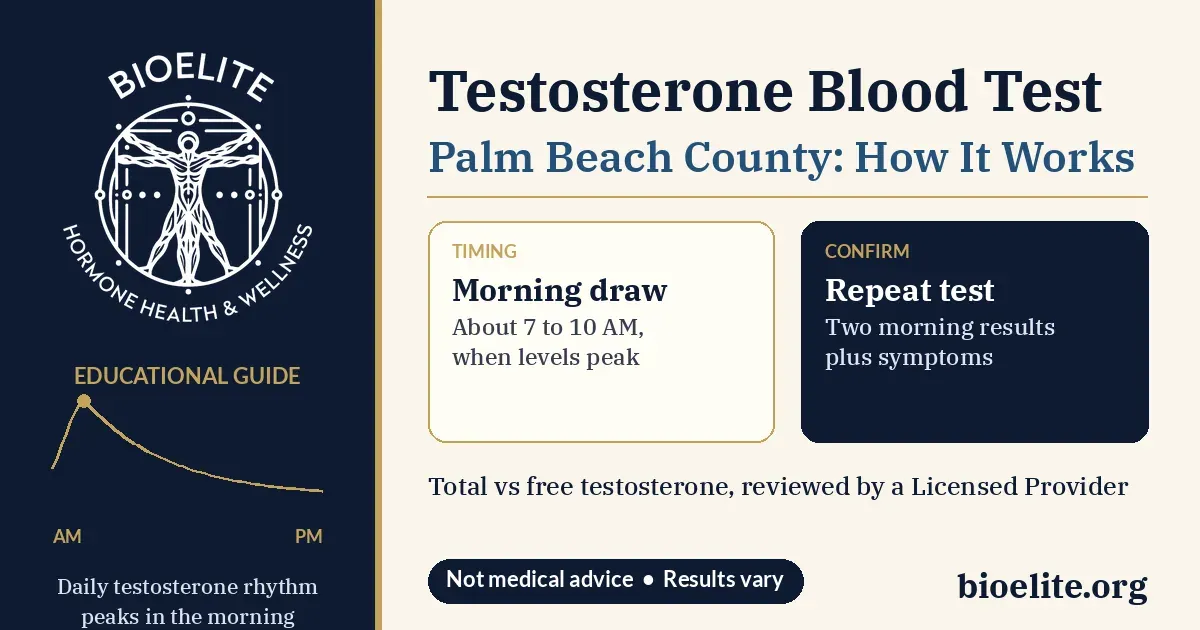
Quick answer: A testosterone blood test measures the testosterone in a small blood sample, usually drawn from a vein in the morning, when levels are typically highest. A Licensed Provider usually starts with total testosterone, and the Endocrine Society says a diagnosis of low testosterone needs at least two early-morning tests plus matching symptoms. In Palm Beach County, a BIOELITE Licensed Provider orders testosterone blood tests through Quest and reviews the results with you.
Last updated: October 18, 2026. Reviewed by the BIOELITE clinical team.
If you searched for a testosterone test near me in Palm Beach County, you probably want to know how the process works before you book. This guide covers who orders the test, when blood is drawn, why one number is rarely the whole story, and what happens next. For more on the numbers, see our guide to free vs total testosterone labs.
What does a testosterone blood test measure?
Testosterone travels in the blood in two forms. Most is bound to proteins, mainly sex hormone binding globulin (SHBG) and albumin; a small share is free. The MedlinePlus guide to testosterone level tests describes three ways to measure it:
Total testosterone: bound plus free testosterone. This is the most common test.
Free testosterone: only the unbound form. Less common, but useful in some situations.
Bioavailable testosterone: free testosterone plus the part bound to proteins other than SHBG. Rarely ordered.
Because SHBG affects how much testosterone the body can use, a clinician may also order an SHBG level. Our article on the SHBG test and free testosterone context explains why.
Who may need a testosterone blood test?
For adult men, the test is mostly used to look into symptoms that may point to low testosterone, such as low sex drive, erection problems, muscle loss, or reduced energy. For women, it is more often used to look into signs of high testosterone, such as extra facial hair, acne, or irregular periods.
Symptoms alone are not enough. The American Urological Association testosterone deficiency guideline defines testosterone deficiency as low testosterone levels combined with related symptoms or signs, and notes that these symptoms are nonspecific and can come from other conditions, such as chronic stress or depressed mood. To compare common symptoms, see signs of low testosterone in men over 40 or our guide to low testosterone in women: symptoms and labs.
How a testosterone blood test works, step by step
Step 1: A Licensed Provider reviews your history
It starts with a review of your symptoms, health history, medicines, and prior labs. The clinician then decides which tests make sense, such as total testosterone alone or a broader panel, and writes the lab order.
Step 2: A morning blood draw at the lab
BIOELITE currently uses Quest for laboratory testing. Ordered labs are drawn at a Quest Diagnostics location, so confirm your order, collection site, and appointment time before you go. The arm draw usually takes under five minutes. Our lab testing page explains how provider-ordered labs are organized.
Step 3: Results and reference ranges
Results often arrive within a few business days. Each report lists your value next to that lab's reference range. The Endocrine Society notes that typical adult male levels fall roughly between 300 and 1,000 ng/dL, depending on age and the lab used, so read your result against your own lab's range, not a number found online.
Step 4: Repeat testing to confirm
If the first result is low or borderline, a repeat morning test is common before any conclusion is drawn. A single value is a snapshot that can shift from day to day.
Why morning timing and repeat tests matter
Testosterone is usually highest in the morning and lowest at night, so most draws happen between about 7 and 10 AM. The Endocrine Society patient guide on hypogonadism states that testosterone must be measured more than once for an accurate assessment, and that a diagnosis needs at least two early-morning blood tests showing low testosterone along with typical signs and symptoms.
Levels can also dip for a while with severe illness, poor nutrition, too much exercise, or certain medicines, such as opioid pain medicines and corticosteroids. Tell your clinician about everything you take, and never stop a prescribed medicine on your own. For fasting questions and what to mention before a draw, read how to prepare for hormone bloodwork.
At-home testosterone kits vs a lab blood draw
At-home kits ask you to collect a finger-prick blood or saliva sample and mail it to a lab. MedlinePlus suggests talking with your provider first. The Cleveland Clinic overview of testosterone tests notes that the accuracy of at-home tests can vary and that people should not try to self-diagnose a testosterone problem.
A provider-ordered morning blood draw, reviewed with your history, gives a clinician more to work with. If you already have a home-kit result, bring it to your visit with the date and time of collection.
What happens after your testosterone results come back
A Licensed Provider reviews the numbers with your symptoms, exam, history, and medicines. An out-of-range result does not always mean a condition that needs treatment, and levels naturally drift lower with age. Next steps may include:
A repeat early-morning total testosterone test to confirm the first result.
Free testosterone or SHBG when total testosterone is borderline.
Tests that help look for a cause, such as LH and FSH. See LH and FSH labs for low testosterone.
A broader review of related markers. Learn what a complete hormone lab panel covers.
Any treatment decision is separate and based on confirmed labs, symptoms, and risks. Our article on who qualifies for TRT covers how clinicians weigh labs and symptoms, and our testosterone therapy page describes how supervised care is organized when it is appropriate.
Questions to bring to your testosterone test visit
Which test are you ordering (total, free, or both), and why?
What time should the blood be drawn, and do I need to fast?
If my result is low or borderline, when should it be repeated?
Should LH, FSH, or SHBG be checked too?
Testosterone blood tests in Palm Beach County and by telehealth
BIOELITE Hormone Health and Wellness is located at 1101 N. Congress Avenue, Suite 100, Boynton Beach, FL 33426, near Lantana, Lake Worth Beach, and Delray Beach. In-person visits are by appointment only, Monday through Friday, 9 AM to 5 PM; walk-ins are not available. We also serve patients across the U.S. through telehealth video visits until 8 PM from home, in states where our providers are licensed. Eligibility rules apply, and messages are answered 24 hours a day. Read about testosterone therapy in Boynton Beach, see our Palm Beach County page, or get directions on BIOELITE on Google Maps.
Practical next steps
Write down your symptoms and when they started.
List all medicines and supplements.
Gather prior testosterone results with the date and time of each draw.
New patients can book at our online booking page, call (561) 821-3005, or use our contact page. Common process questions are answered on our FAQ.
Existing clients can use our existing-client booking page.
Browse more in our Hormone Lab Testing Guides or see all health guides.
Frequently asked questions about testosterone blood tests
What time of day is a testosterone blood test done?
Usually in the morning, between about 7 and 10 AM, when levels are typically highest. Your Licensed Provider and lab order will tell you the timing and whether fasting is needed.
Is one low testosterone result enough for a diagnosis?
Usually not. The Endocrine Society says a diagnosis needs at least two early-morning blood tests showing low levels, plus fitting signs and symptoms. Illness and some medicines can lower a single result.
What is the difference between total and free testosterone?
Total testosterone measures both the protein-bound and unbound forms. Free testosterone measures only the unbound part. Total is the usual first test, and free may be added in some cases.
Where can I get a testosterone blood test in Palm Beach County?
BIOELITE Hormone Health and Wellness offers appointment-only visits at 1101 N. Congress Avenue, Suite 100, Boynton Beach, FL 33426, plus telehealth in states where our providers are licensed. A Licensed Provider orders labs through Quest. New patients can book online or call (561) 821-3005.
Medical disclaimer: This article is general education, not medical advice. It does not diagnose any condition, recommend medications or doses, or tell you to start, stop, or change any medication. Source summaries reflect public information as of October 2026. Lab ranges vary by laboratory. Testing and treatment decisions require a licensed clinician. Individual results vary. Care depends on clinical eligibility and licensure; please confirm visit hours when scheduling.