
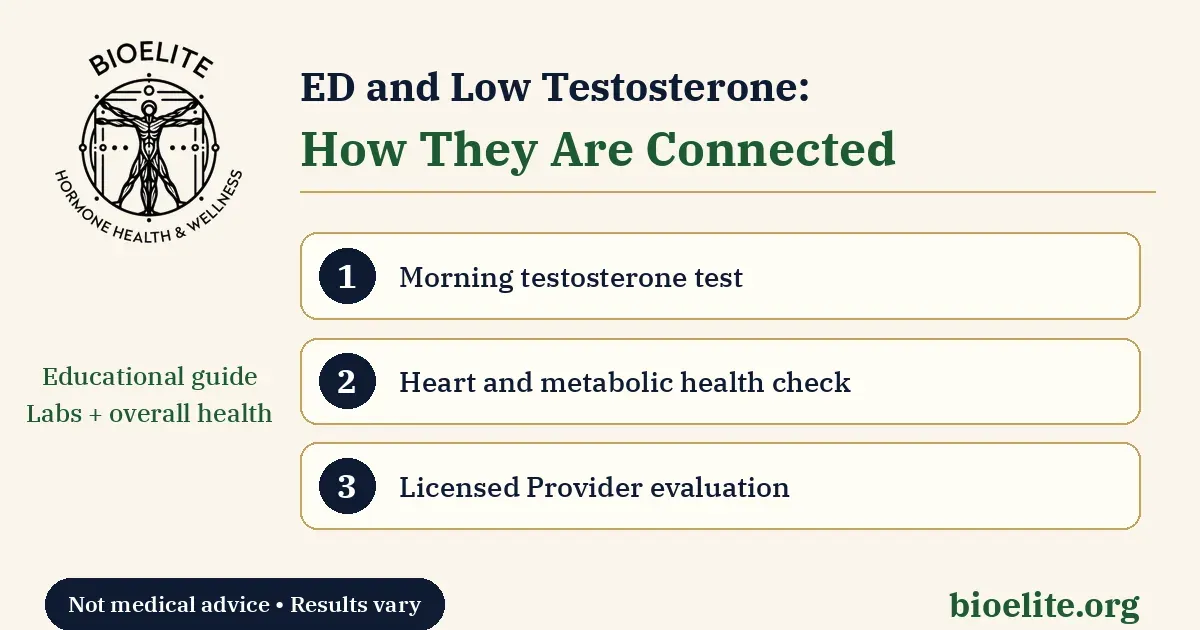
ED and Low Testosterone: How They're Connected | BIOELITE
Educational content only. This article does not diagnose, treat, or prescribe, and it does not promise outcomes. Always discuss personal medical decisions with a licensed clinician. Individual results vary.
If you have been searching for ED treatments in Lake Worth, ED treatment in Boynton Beach, or simply wondering whether low testosterone is behind changes in erections, you are asking a common and reasonable question. Erectile dysfunction (ED) and low testosterone can overlap, but they are not the same thing, and one does not automatically explain the other.
This guide explains how ED and testosterone are connected, what national urology guidelines recommend checking, the other common contributors a clinician looks at, and how BIOELITE Hormone Health and Wellness approaches the evaluation. It does not recommend specific medications or doses, and it makes no promises about outcomes.
What ED is, and why hormones come up
ED is the consistent or recurrent difficulty getting or keeping an erection firm enough for satisfying sexual activity. An occasional off night is normal. A pattern that lasts for weeks or months is worth a medical conversation, partly because of what it can signal about overall health.
Hormones come up because testosterone plays a role in sexual desire and in the body systems that support erections. Many men assume that low testosterone is the cause. Sometimes it is part of the picture, but often it is not the main driver.
How testosterone and erections are connected
An erection depends on healthy blood vessels, nerves, and smooth muscle, along with desire and arousal signals from the brain. Testosterone is most closely linked to sexual desire (libido). Its effect on the mechanics of an erection is real but more limited.
The American Urological Association (AUA) notes that the most common underlying mechanism of ED is vascular, meaning it relates to blood flow. That is why ED and low testosterone can show up together without one fully causing the other. Both become more common with age and with conditions such as diabetes, obesity, and high blood pressure.
A practical way to think about it: low testosterone is more likely to show up as lower interest in sex, fewer spontaneous erections, low energy, or mood changes. ED with normal desire points more toward blood flow, nerve, medication, or stress factors. Our article on the signs of low testosterone in men over 40 covers the broader symptom picture.
What guidelines recommend checking
The AUA guideline on erectile dysfunction recommends that men with ED receive a thorough medical, sexual, and psychosocial history, a physical examination, and selective laboratory testing. Two points stand out:
Testosterone: the AUA recommends measuring a morning total testosterone level in men with ED. It defines testosterone deficiency as a total testosterone below 300 ng/dL together with symptoms or signs, so a single number is never the whole story.
Heart and metabolic health: the AUA advises that men be counseled that ED is a risk marker for underlying cardiovascular disease and other health conditions that may need evaluation. Blood sugar (glucose or A1C) and lipids are the other labs the guideline highlights as most likely to matter.
Because testosterone naturally varies through the day and can be affected by illness, sleep, and some medications, a clinician may repeat a low result before drawing conclusions. See our guide to free vs total testosterone lab numbers and our article on A1C and lipids on a hormone panel for how those results are read. BIOELITE currently uses Quest for laboratory testing, and our lab testing page explains how supervised labs are organized.
Other common contributors to ED
ED often has more than one contributor. A careful evaluation usually considers:
Blood vessel health, including high blood pressure, high cholesterol, smoking history, and diabetes.
Weight, physical activity, alcohol use, and sleep, including possible sleep apnea.
Medications, such as some blood pressure, antidepressant, and prostate medicines. Never stop a prescribed medication without talking to the clinician who prescribed it.
Stress, anxiety, depression, and relationship factors, which the AUA guideline recognizes as part of a full evaluation.
Prior pelvic surgery, injury, or nerve conditions.
Sleep is a frequent overlap point. Our article on sleep apnea and low testosterone explains why evaluating both can matter.
When low testosterone and ED overlap
When labs and symptoms together point to testosterone deficiency, a Licensed Provider may discuss whether testosterone therapy fits your situation, alongside other ED options. The AUA guideline notes that for men with ED and testosterone deficiency, oral ED medicines may be more effective when combined with testosterone therapy. That is a clinical decision made for an individual, not a rule for everyone.
Testosterone therapy is not a stand-alone ED treatment for men with normal testosterone, and it has trade-offs. It can reduce sperm production, it requires monitoring labs such as hematocrit, and it is not right for everyone. Our hematocrit monitoring on TRT article explains one reason follow-up labs matter. Broader options for erectile concerns are covered on our sexual health page and in our overview of ED medications for men, and testosterone evaluation is covered on our testosterone therapy page.
Questions to bring to your visit
Should my morning testosterone be checked, and should it be repeated?
Do my symptoms point more toward hormones, blood flow, medications, sleep, or stress?
Should my blood sugar, lipids, and blood pressure be reviewed because of ED?
If testosterone is low, what are the options, and how would therapy affect fertility?
What follow-up labs and visits would be expected?
When to seek urgent care
Seek emergency care for chest pain, shortness of breath, or fainting during or after sexual activity, or for an erection that lasts longer than four hours. This is general education, not a substitute for a clinician's advice.
Visits in Boynton Beach, Lake Worth, and by telehealth
BIOELITE is located at 1101 N. Congress Ave, Suite 100, Boynton Beach, FL 33426, a short drive for many patients in Lake Worth Beach, Lantana, and Wellington. In-person visits at the Boynton Beach office are by appointment only, Monday through Friday, 9 AM to 5 PM. Walk-ins are not available. Telehealth video visits are available until 8 PM from the comfort of your own home in Lake Worth and anywhere our providers are licensed. Eligibility and licensure rules always apply, and messages are answered 24 hours a day. For nearby logistics, see our Wellington and Lake Worth hormone care guide and our Palm Beach County page.
Practical next steps
Note when the changes started, how often they happen, and whether desire has also changed.
List your medications and supplements, plus any heart, blood pressure, diabetes, or sleep history.
Gather prior labs with dates, especially testosterone, A1C, and lipids.
Ask for an evaluation that looks at hormones and overall health together.
Choose an in-person Boynton Beach visit or an eligible telehealth visit.
New patients can book at schedule.bioelite.org, call (561) 821-3005, or use our contact page. Common process questions are answered on our FAQ.
Medical disclaimer: This article is for general education only and is not medical advice. It does not diagnose erectile dysfunction, testosterone deficiency, or any other condition; it does not recommend specific medications, doses, or self-directed protocols; and it does not instruct you to start, stop, or change any medication. Guideline summaries reflect publicly available American Urological Association guidance as of October 2026 and may change. Evaluation and any testing or treatment decisions require a licensed clinician. Individual results vary. Availability of in-person and telehealth care depends on clinical eligibility and applicable licensure. Visit hours may change; please confirm when scheduling.
