
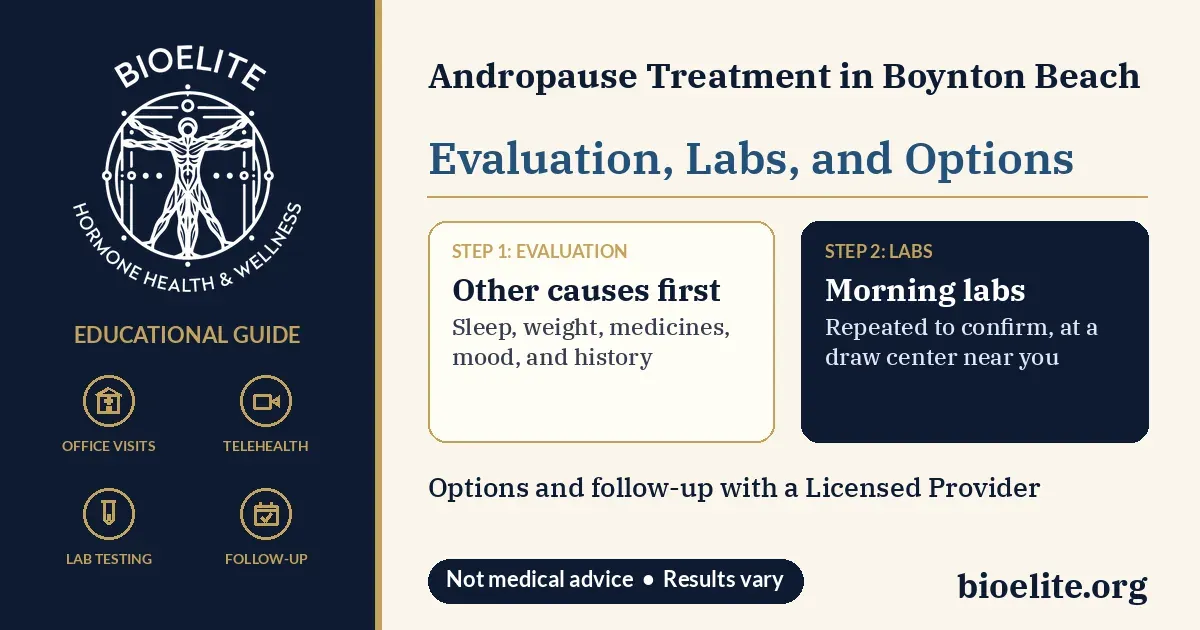
Andropause Treatment in Boynton Beach, FL | BIOELITE
Educational content only. This article does not diagnose, treat, or prescribe, and it does not promise outcomes. Always discuss personal medical decisions with a licensed clinician. Individual results vary.
Quick answer: Andropause treatment usually starts with an evaluation, not a prescription. A Licensed Provider reviews your symptoms, health history, sleep, and medicines, looks for other causes, and orders morning labs when appropriate, drawn at a draw center convenient for you. If age-related low testosterone is confirmed, options and risks are discussed, and follow-up keeps any plan under review.
Last updated: October 27, 2026. Reviewed by the BIOELITE clinical team.
Men who search for andropause treatment in Boynton Beach, FL are usually asking a practical question: something has changed with energy, sleep, drive, or mood after 40, and they want to know what can actually be done about it. This guide walks through that treatment-evaluation journey at BIOELITE Hormone Health and Wellness, step by step: sorting age-related change from other causes, labs, the options a Licensed Provider may discuss, and follow-up.
If you want the definitions first, read andropause vs low testosterone. If you already know you want to talk about testosterone therapy itself, our testosterone therapy in Boynton Beach guide covers what to expect on that pathway. This article focuses on the decisions in between.
What andropause treatment usually means
Andropause is not a formal diagnosis. The closest medical idea is age-related low testosterone, sometimes called late-onset hypogonadism. The Endocrine Society testosterone therapy guideline notes that testosterone levels fall gradually with age, that the pace varies from man to man, and that the decline tends to be larger in men with excess weight and other health conditions.
That is why treatment for andropause is rarely just one thing. Depending on what an evaluation finds, a plan may focus on:
Managing another cause that better explains the symptoms
Lifestyle steps such as sleep, activity, and weight, alongside care for existing conditions
Watching and rechecking when results are borderline
Prescription hormone options, considered only after a Licensed Provider confirms low testosterone and reviews the possible benefits and risks with you
Step 1: Age-related decline or something else?
Many symptoms men link to andropause, such as tiredness, lower drive, poor sleep, or a flat mood, are common and not specific to testosterone.
For men in their 40s, 50s, and 60s, a Licensed Provider will often ask about sleep and possible sleep apnea, weight and blood sugar, blood pressure, alcohol, stress and mood, and current medicines, since some medicines can affect hormones or libido. Our article on sleep apnea and low testosterone explains one of the most common overlaps.
You can make this step easier by bringing a short timeline of what changed and when, a list of your medicines and supplements, and any recent lab results. Mention whether fertility matters to you now or later, because it can change which options make sense.
Step 2: Labs, drawn at Quest near you
Labs help confirm or rule out low testosterone. MedlinePlus explains on its testosterone levels test page that blood is usually drawn in the morning, between 7 and 10, when levels are typically highest, and that it is normal for testosterone to decrease with age. The Endocrine Society recommends diagnosing low testosterone only when symptoms fit and morning levels are consistently low, confirmed with a repeat test.
Blood draws are not done at our Boynton Beach office. A Licensed Provider orders the labs, and you go to a draw center convenient for you; BIOELITE currently uses Quest, so many men pick a location near home or work. Our guide to the testosterone blood test in Palm Beach County walks through the local steps, and free vs total testosterone explains two numbers you may see. See our lab testing page for how lab work is organized.
For men over 50, the first panel may look beyond testosterone. Depending on your history, a provider may also check a blood count, including hematocrit, PSA, and metabolic markers. These help explain symptoms and give a baseline if treatment is ever considered.
Step 3: Options a Licensed Provider may discuss
When another cause is found
If the evaluation points to something else, such as a sleep problem or a medicine side effect, that cause is usually addressed first, sometimes together with your primary care clinician. A later recheck shows whether testosterone is still low.
When results are borderline
MedlinePlus notes that a result outside the typical range does not always mean a condition that needs treatment. When numbers sit near the edge of the range, watching, repeating labs, and revisiting symptoms over time can be a reasonable plan.
When age-related low testosterone is confirmed
This is where age matters. The Endocrine Society suggests against routinely prescribing testosterone to all men 65 or older with low levels. For men over 65 with symptoms such as low libido or unexplained anemia and consistently low morning levels, it suggests that clinicians offer testosterone on an individualized basis after an explicit discussion of the potential risks and benefits.
The American College of Physicians guideline on age-related low testosterone suggests that clinicians discuss testosterone treatment with men who have sexual dysfunction and want to improve it, and reevaluate symptoms within 12 months. It also suggests that clinicians not start testosterone for age-related low levels to improve energy, vitality, physical function, or cognition.
The FDA states that testosterone is approved for men who have low testosterone together with an associated medical condition. In its 2025 testosterone labeling update, the FDA kept the Limitation of Use language for age-related hypogonadism. None of this means older men are never treated. It means the decision is individual, made with a Licensed Provider after confirmed labs and an honest conversation about expected benefits, risks, and alternatives.
Prescription forms and other approaches
The FDA lists current approved testosterone forms as including oral, topical gel, transdermal patch, buccal, and injectable products. Our comparison of testosterone cream, gel, and injections covers practical differences. Men who want to protect fertility sometimes ask about approaches that aim to support the body's own production rather than replace it. These are prescription-only, are not right for everyone, and are considered only after evaluation; see hormone stimulation versus replacement. This article does not recommend any product or dose.
Step 4: Follow-up and monitoring
Follow-up is part of responsible care for any plan, including a plan to watch and recheck. If testosterone is started, the FDA's 2025 update added a class-wide warning that testosterone products can increase blood pressure, so blood pressure checks belong in follow-up. The same update added results of the TRAVERSE trial, which the FDA summarized as showing no increase in the risk of adverse cardiovascular outcomes in men using testosterone for hypogonadism.
The Endocrine Society recommends a standardized monitoring plan that includes symptoms, side effects, and adherence, testosterone levels and hematocrit, and prostate cancer risk evaluation. For men 55 to 69, it suggests shared decision-making about prostate monitoring. Our articles on hematocrit monitoring on TRT and PSA monitoring on TRT go deeper. Follow-up labs are drawn at Quest like the first ones, and a plan can be adjusted or stopped.
Andropause care in Boynton Beach and by telehealth
Men looking for andropause treatment in Boynton Beach, Delray Beach, Lake Worth, or nearby can visit our office at 1101 N. Congress Avenue, Suite 100, Boynton Beach, FL 33426, serving Palm Beach County and South Florida. In-person visits are by appointment only, Monday through Friday, 9 AM to 5 PM; we do not take walk-ins. You can find our Boynton Beach office on Google Maps, and our testosterone therapy page outlines how BIOELITE approaches men's hormone care.
Telehealth video visits are available seven days a week, 8 AM to 8 PM Eastern, for patients in states where our Licensed Providers are licensed. Many men use telehealth for the first symptom review, lab reviews, and follow-ups; see how an online telehealth TRT evaluation works.
Questions to bring to an andropause evaluation
Besides testosterone, what else could explain my symptoms?
Which labs do you recommend, and should they be repeated in the morning?
If my levels are low, what do the guidelines say for a man my age?
What are the possible benefits, risks, and alternatives for someone with my history?
What will follow-up look like, and when would we adjust or stop a plan?
Practical next steps
New patients can book at our online booking page, call (561) 821-3005, or use our contact page. Common process questions are answered on our FAQ.
Existing clients can use our existing-client booking page.
Browse more in our Testosterone and TRT Guides or see all health guides.
Frequently asked questions about andropause treatment
Is andropause treatment the same as testosterone therapy?
Not always. Andropause is a popular term, not a formal diagnosis. Depending on what an evaluation finds, a plan may focus on another cause of symptoms, lifestyle steps, watching and rechecking labs, or a discussion of prescription testosterone options when low testosterone is confirmed. A Licensed Provider explains which, if any, fits you.
Do I need blood work before andropause treatment?
Yes, labs are usually part of the evaluation. MedlinePlus notes that testosterone is usually tested in the morning, between 7 and 10, when levels are typically highest, and the Endocrine Society recommends confirming a low result with a repeat morning test. Blood draws are not done at our office; you go to a draw center convenient for you, currently Quest.
Is testosterone FDA-approved for age-related decline?
The FDA states that testosterone is approved for men who have low testosterone together with an associated medical condition. In its 2025 class-wide labeling update, the FDA kept the Limitation of Use language for age-related hypogonadism. A Licensed Provider can explain what this means for your situation.
Can an andropause evaluation start by telehealth?
Often, yes. Symptom reviews, lab orders, lab reviews, and follow-ups usually work well by video, seven days a week from 8 AM to 8 PM Eastern, where our Licensed Providers are licensed. In-person visits at our Boynton Beach office are by appointment only, Monday through Friday, 9 AM to 5 PM, with no walk-ins.
How often is follow-up if treatment is started?
It depends on the plan. The Endocrine Society recommends a standardized monitoring plan that includes symptoms, side effects, testosterone levels, hematocrit, and prostate risk evaluation, and the American College of Physicians suggests reevaluating symptoms within 12 months and periodically after that. Your Licensed Provider sets the schedule.
Medical disclaimer: This article is general education, not medical advice. It does not diagnose andropause, low testosterone, or any other condition, recommend medications or doses, or tell you to start, stop, or change any medication. Testing and treatment decisions require a licensed clinician. Individual results vary. Care depends on clinical eligibility and licensure; please confirm visit hours when scheduling.