
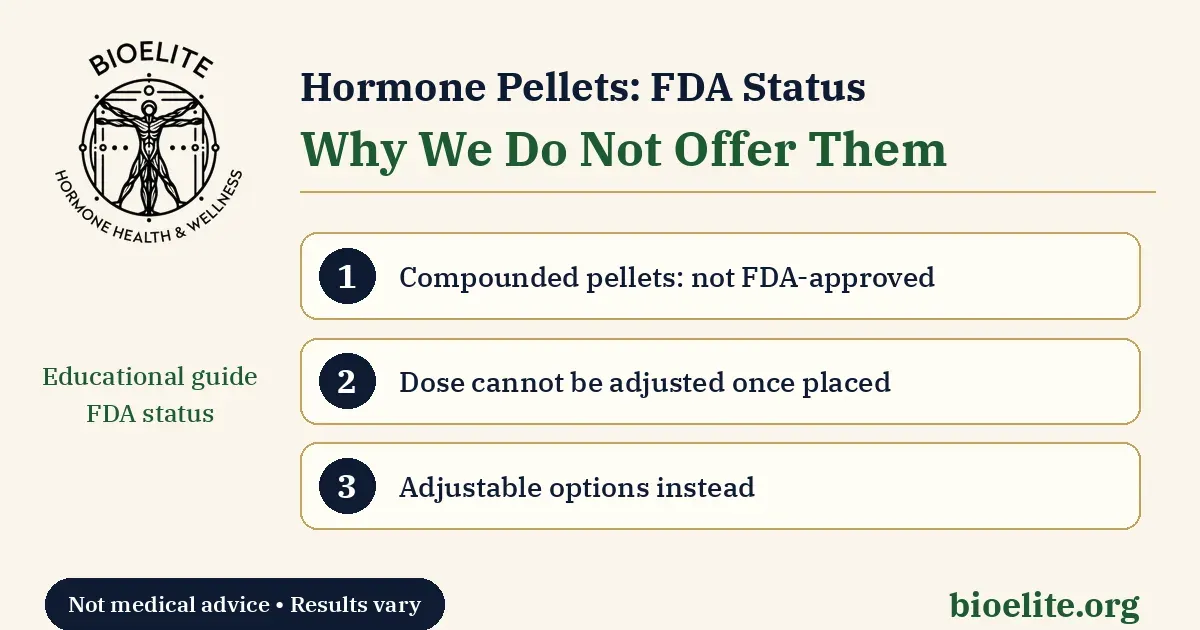
Hormone Pellets: FDA Status and Why We Do Not Offer Them
Educational content only. This article does not diagnose, treat, or prescribe, and it does not promise outcomes. Always discuss personal medical decisions with a licensed clinician. Individual results vary.
If you are searching for hormone pellets in Boynton Beach, hormone pellets near me in Palm Beach County, or pellet therapy near me, you may be trying to understand what hormone pellets are, whether they are FDA-approved, and what the alternatives look like. Marketing often blurs the line between an FDA-approved product and a compounded one.
This guide explains what hormone pellets are, what their FDA status is, why BIOELITE Hormone Health and Wellness does not offer them, and what BIOELITE offers instead. It does not recommend doses, products, or protocols, and it makes no promises about outcomes.
What hormone pellets are
Hormone pellets are small solid implants placed under the skin by a clinician. They are designed to release hormone, most often testosterone or estradiol, over a period of months. Once the pellets are placed, the hormone keeps releasing on its own schedule.
Pellets are often described as "bioidentical." That word means the hormone molecule is chemically the same as one made by the human body. It does not mean the preparation is FDA-approved, safer, or better studied.
FDA status: compounded pellets vs an approved product
Compounded hormone pellets are not FDA-approved. The FDA states that it does not review compounded drugs for safety, effectiveness, or quality before they are marketed. That includes compounded estradiol pellets, compounded testosterone pellets, and combination "BHRT" pellets.
In an FDA statement about adverse event reporting, the agency described reports linked to compounded testosterone pellets, including pellet extrusion and cellulitis. The same statement notes that compounded bioidentical hormone products are sometimes marketed as more natural or safer than FDA-approved drugs, and that because they are not approved there is no assurance of safety and effectiveness.
In 2020, the National Academies of Sciences, Engineering, and Medicine (NASEM) reviewed compounded bioidentical hormone therapy for the FDA. NASEM found a lack of rigorous evidence of safety and effectiveness from well-designed clinical studies, found that most of the available information came from low-quality sources such as anecdotes and testimonials, and concluded that wide-spread use poses a public health concern.
What the FDA-approved testosterone pellet is labeled for
One testosterone pellet product, Testopel, is FDA-approved. Its labeling covers testosterone replacement in males with primary hypogonadism or hypogonadotropic hypogonadism, and use to stimulate puberty in carefully selected males with clearly delayed puberty. The labeling also states that safety and efficacy in men with age-related (late-onset) hypogonadism have not been established.
That approval does not cover compounded pellets, and it is not an approval for women. The manufacturer's dosing information also notes that pellet implantation is much less flexible for dose adjustment than oral products or injections.
For women, ACOG states that there is no FDA-approved testosterone formulation for menopausal symptoms. ACOG cites the lack of safety data and raises concerns with pellets, including that the dose cannot be adjusted once placed and that the hormone keeps releasing after placement. ACOG recommends preparations other than pellet therapy for delivering testosterone, and advises that compounded bioidentical menopausal hormone therapy should not be prescribed routinely when FDA-approved formulations exist.
Why BIOELITE does not offer hormone pellets
BIOELITE does not offer hormone pellets. The reasons are practical and clinical:
Once pellets are placed, the dose cannot be adjusted. If side effects occur, the hormone continues to release until the pellets dissolve, and removal, when it is possible, requires a minor procedure and may not stop the effects right away.
Compounded pellets are not FDA-approved, and the one FDA-approved testosterone pellet product is labeled for specific conditions in men.
Safe hormone care relies on being able to change course. That means adjusting a dose or stopping when labs or symptoms call for it.
Other clinics make their own clinical decisions, and many clinicians have reasons for their approach. This is simply BIOELITE's position: we prefer options that stay adjustable.
What BIOELITE offers instead
BIOELITE focuses on hormone care that can be changed or stopped. Depending on your evaluation, eligibility, and state licensure, a Licensed Provider may discuss formats such as injections, topical products, or oral options. Dose changes are made by a Licensed Provider based on labs and symptoms, with follow-up monitoring. Whether any hormone therapy is appropriate is an individual clinical decision, and not every format fits every person.
Evaluation begins with a Licensed Provider reviewing your symptoms, history, medications, goals, and prior labs. BIOELITE currently uses Quest for laboratory testing. See our lab testing page and our guide to estradiol labs for women in HRT care for how supervised labs are organized. For comparing adjustable formats, see our comparison of testosterone cream, gel, and injections and our bioidentical hormone therapy guide.
Questions to ask any clinic about pellets
Is the product FDA-approved, or is it compounded?
Can the dose be changed after the pellets are placed? If not, what is the plan if labs or symptoms change?
What would removal involve, and is it always possible?
What monitoring labs and follow-up visits are expected?
Were FDA-approved or adjustable options discussed first?
If you already have pellets and are concerned about side effects, contact the clinician who placed them. Seek urgent medical care for severe symptoms such as chest pain, fainting, heavy uncontrolled bleeding, or sudden neurologic changes. This is general education, not a substitute for a clinician's advice.
Who may want a different conversation first
Consider a careful clinician discussion, and sometimes specialty input, when any of the following apply:
Unexplained abnormal uterine bleeding, a history of hormone-sensitive cancer, blood clots, stroke, heart disease, or liver disease.
Plans for pregnancy, current pregnancy, or breastfeeding.
Prior problems with hormone therapy, including high levels, mood changes, or androgenic side effects.
Interest in a hormone format mainly because of online marketing rather than a documented hormone problem.
Menopause and perimenopause questions are common. Our menopause treatment options guide and perimenopause hormone evaluation post provide related literacy.
Telehealth and in-person visits
BIOELITE is located at 1101 N. Congress Ave, Suite 100, Boynton Beach, FL 33426, and serves patients throughout the US via telehealth plus supervised care when clinical and regulatory factors allow. In-person visits at the Boynton Beach office are by appointment only, Monday through Friday, 9 AM to 5 PM. Walk-ins are not available. Telehealth video visits are available until 8 PM in states where our providers are licensed, and all states will be available soon. Eligibility and licensure rules always apply, and messages are answered 24 hours a day. For local logistics, see our Boynton Beach hormone therapy guide. Nearby communities are covered on our Palm Beach County page.
Practical next steps
Write down your symptoms, when they started, and what has already been tried.
Gather prior hormone labs and imaging with dates, plus a list of medications and supplements.
Ask whether FDA-approved or adjustable options fit your situation.
Ask how dosing would be changed if labs or symptoms change, and how therapy would be stopped if needed.
Choose an in-person Boynton Beach visit or an eligible telehealth visit.
Call (561) 821-3005 or use our contact page to schedule. Common process questions are answered on our FAQ. Broader hormone care context is on our hormone replacement therapy page. Related women's hormone literacy is also on our bioidentical hormone therapy for women guide.
Medical disclaimer: This article is for general education only and is not medical advice. It does not diagnose hormone deficiency, menopause-related conditions, or any other condition; it does not recommend doses, products, or self-directed protocols; and it does not instruct you to start, stop, or change any medication or procedure. Regulatory and clinical summaries reflect publicly available FDA, NASEM (2020), ACOG, and product-labeling information as of October 2026 and may change. Evaluation and any testing or treatment decisions require a licensed clinician. Individual results vary. Availability of in-person and telehealth care depends on clinical eligibility and applicable licensure. Visit hours may change; please confirm when scheduling.
