
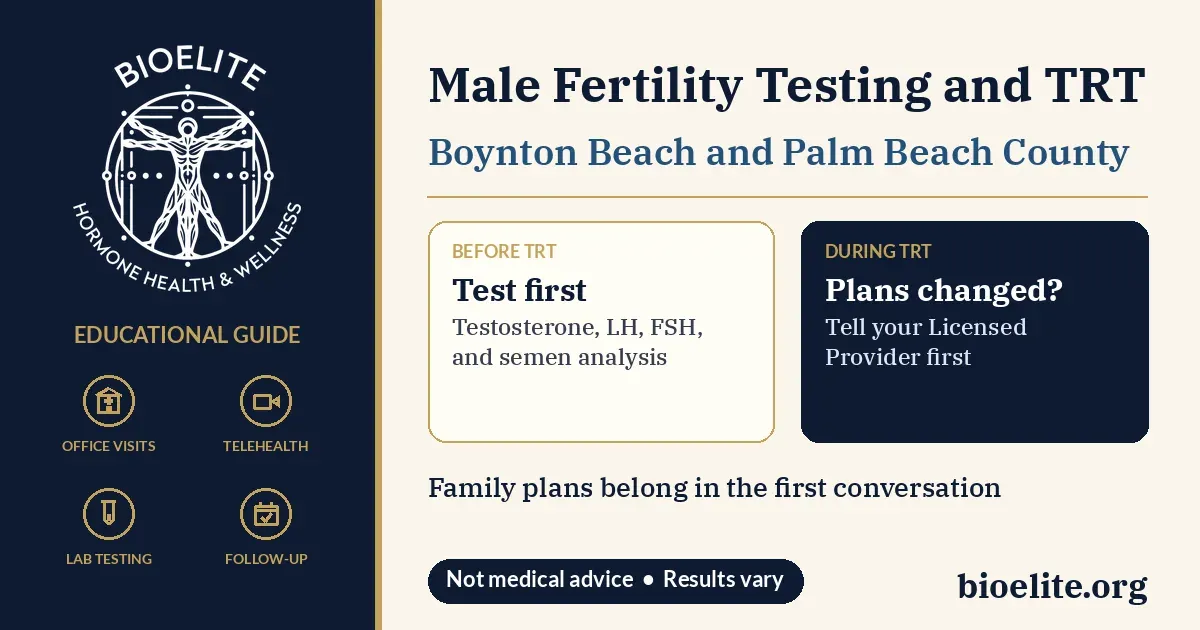
Male Fertility Testing and TRT in Boynton Beach | BIOELITE
Educational content only. This article does not diagnose, treat, or prescribe, and it does not promise outcomes. Always discuss personal medical decisions with a licensed clinician. Individual results vary.
Quick answer: Testosterone therapy can lower sperm production because testosterone from outside the body signals the brain to send less LH and FSH to the testicles. A fertility-aware evaluation usually checks morning testosterone, LH, FSH, and, when needed, estradiol, prolactin, and a semen analysis, ideally before therapy starts and again if family plans change.
Last updated: October 29, 2026. Reviewed by the BIOELITE clinical team.
Men searching for male fertility testing in Boynton Beach often have one practical question: if I start testosterone therapy, what happens to my chances of having children? It is a fair question, and the honest answer starts with testing rather than guessing. This guide explains why testosterone therapy and fertility are linked, what a fertility-aware evaluation at BIOELITE Hormone Health and Wellness usually checks, when to test before and during therapy, and when a urologist or fertility clinic should be part of the plan.
If you are already comparing treatment options, read our guide to hCG with TRT and fertility-aware care and our article on whether enclomiphene preserves fertility. This article stays on the testing side: what to measure, when, and why.
Why testosterone therapy can affect sperm production
Sperm production depends on two signals from the pituitary gland. MedlinePlus explains that in men, LH causes the testicles to make testosterone, which is important for making sperm, and that FSH helps control the amount of sperm the testicles make.
When testosterone is given from outside the body, the brain senses higher levels and sends out less LH and FSH. The AUA/ASRM guideline on infertility in men describes how this negative feedback can inhibit those signals, so sperm production may decrease or stop altogether. The guideline notes that sperm often return after testosterone is stopped, but recovery can take months, rarely years, and some men do not fully recover.
For that reason, the Endocrine Society testosterone therapy guideline recommends against starting testosterone therapy in men planning fertility in the near term, and the AUA/ASRM guideline advises clinicians not to prescribe testosterone therapy for men interested in current or future fertility. Family plans are part of the conversation from the first visit, not an afterthought.
What a fertility-aware evaluation usually checks
The American Urological Association testosterone deficiency guideline recommends that men with low testosterone who are interested in fertility have a reproductive health evaluation before treatment. Tests are chosen based on your history, not as a fixed package. Here is what that evaluation often includes.
Morning testosterone: total and free
Testosterone is usually measured from a morning blood sample, because levels drop later in the day, and a low result is typically repeated before any decision. Total testosterone may be paired with free testosterone and SHBG, the protein that binds much of it. Our guides to free vs total testosterone and SHBG labs explain how those numbers relate.
LH and FSH
LH and FSH show how strongly the pituitary is signaling the testicles. Together with testosterone, they help a Licensed Provider see whether a low level looks more like a signaling issue or a testicular production issue. The AUA notes that a high FSH alongside low testosterone often points to impaired sperm production, in which case a semen analysis should be considered. For more detail, see LH and FSH labs in a low testosterone evaluation.
Estradiol and prolactin
When morning testosterone is low, the AUA/ASRM guideline describes repeating total and free testosterone and checking LH, estradiol, and prolactin. Prolactin is especially relevant when testosterone is low and LH is low or normal, since a high prolactin level can affect both hormones and fertility. Read more about estradiol in men and prolactin labs.
Semen analysis
Blood work shows hormone signals, but it cannot show what is actually in a semen sample. MedlinePlus describes a semen analysis as a test of semen volume, sperm count and concentration, movement, and shape. You usually avoid ejaculation for 2 to 7 days beforehand and provide the sample in a private room at a lab. Because results vary from day to day, more than one sample is often needed, and the AUA/ASRM guideline notes that two analyses about a month apart are worth considering, especially if the first is abnormal.
A semen analysis is separate from a blood draw. It is handled by a lab or clinic that processes semen samples, often in coordination with a urologist or fertility clinic, and your Licensed Provider can explain how it is arranged for you.
History and examination
Expect questions about how long you have been trying to conceive, any prior pregnancies, past use of testosterone or other hormones, medicines and supplements, surgeries, injuries, and past illnesses. The AUA also recommends a testicular examination for men with low testosterone who want to preserve fertility, which is done in person.
When to test: before and during testosterone therapy
Before starting therapy
Testing before any treatment decision makes the most sense if:
You and your partner are trying to conceive now, or may in the next year or two
You are not sure whether you want children in the future
You have used testosterone or other hormones before
You have a history of testicular injury, an undescended testicle, or treatment that can affect sperm production
You and your partner have been trying for 12 months or more without a pregnancy
Blood draws are not done at our Boynton Beach office. When a Licensed Provider orders labs, you go to a draw center convenient for you; BIOELITE currently uses Quest. Our lab testing page explains how lab work is organized, and our tips on preparing for hormone blood work cover timing and fasting questions.
During therapy
Family plans can change after therapy begins. If they do, tell your Licensed Provider before you stop or change anything. The AUA recommends discussing the long-term impact of testosterone on sperm production with men interested in future fertility, and stopping therapy in advance of trying to conceive, under clinical guidance. Follow-up hormone labs and a semen analysis may be repeated to see where things stand. Never stop or adjust a prescribed medicine on your own.
Where hCG and other medicines fit
You may see hCG mentioned in these conversations. The AUA/ASRM guideline describes hCG as an injectable medicine that acts like LH and notes that it is FDA-approved for men with hypogonadotropic hypogonadism; some studies added it to testosterone to help maintain sperm production, but the guideline says that evidence is too limited to recommend the approach. The same guideline notes that oral medicines called SERMs are not FDA-approved for use in men. Any of these is a prescription decision made only if a Licensed Provider decides it is appropriate, and none can promise a fertility outcome. Our testosterone therapy page describes how BIOELITE looks at your own production before replacement.
When a urologist or fertility clinic should be involved
Some findings call for a clinician who focuses on male reproductive health. The AUA/ASRM guideline recommends that both partners be evaluated together when a couple has trouble conceiving. A referral to a urologist or fertility clinic is often considered when:
A semen analysis shows one or more abnormal results, or very few or no sperm
FSH is high and testosterone is low, which can point to impaired sperm production
Prolactin stays high on repeat testing
There is a history of testicular surgery, injury, or cancer treatment
Sperm production has not returned after stopping testosterone or other hormones
A couple has been trying for a year or more without a pregnancy
Your Licensed Provider can talk through when a referral makes sense and which results to bring with you.
Office or telehealth: options in Boynton Beach and Palm Beach County
Our office is at 1101 N. Congress Avenue, Suite 100, Boynton Beach, FL 33426, a short drive for many men in Boynton Beach, Lake Worth Beach, Delray Beach, and West Palm Beach, and we serve Palm Beach County and South Florida. In-person visits are by appointment only, Monday through Friday, 9 AM to 5 PM; we do not take walk-ins. You can find our Boynton Beach office on Google Maps. Men looking for low testosterone fertility treatment in West Palm Beach can also read our West Palm Beach TRT and hormone care guide.
Telehealth video visits are available seven days a week, 8 AM to 8 PM Eastern, for patients in states where our Licensed Providers are licensed. Many men start by telehealth, complete blood work at a nearby draw center, and review results by video. Care depends on clinical eligibility and licensure.
Questions to bring to your visit
Do my plans to have children change which tests make sense now?
Which hormones should be checked, and should any be repeated?
Do I need a semen analysis before deciding on therapy, and how is it arranged?
If I start therapy, how will fertility be monitored?
At what point would you suggest a urologist or fertility clinic?
Practical next steps
New patients can book at our online booking page, call (561) 821-3005, or use our contact page. Common process questions are answered on our FAQ.
Existing clients can use our existing-client booking page.
Browse more in our Hormone Health Articles and Guides or see all health guides.
Frequently asked questions about male fertility testing and TRT
Does testosterone therapy always lower sperm count?
Not to the same degree in every man, but it can. Testosterone from outside the body can quiet the LH and FSH signals the testicles rely on, and sperm production may drop or stop. Recovery after stopping often happens, but the time it takes varies and can be many months. That is why fertility plans are discussed before therapy starts.
Should I get a semen analysis before starting TRT?
If you want children now or may want them in the future, a fertility-aware evaluation before treatment is worth discussing. Whether a semen analysis is part of it depends on your history, your hormone results such as FSH, and your plans. A Licensed Provider reviews this with you and explains how the test is arranged.
Are fertility labs drawn at the Boynton Beach office?
No. Blood draws are not done at our Boynton Beach office. When a Licensed Provider orders blood work, you go to a draw center convenient for you, currently Quest. A semen analysis is a separate test that is handled by a lab or clinic that processes semen samples, and your Licensed Provider can explain the steps.
Can I keep taking testosterone while trying to conceive?
Major urology and endocrine guidelines advise against testosterone therapy for men who are trying to conceive or planning to soon. If your plans change while you are on therapy, tell your Licensed Provider before you stop or change anything. Do not stop or adjust a prescribed medicine on your own.
Can fertility testing start by telehealth?
Often, yes. Many men start with a telehealth video visit, available seven days a week from 8 AM to 8 PM Eastern in states where our Licensed Providers are licensed, and then complete blood work at a nearby draw center. Some parts of an evaluation, such as an examination, are done in person. Office visits in Boynton Beach are by appointment only, Monday through Friday, 9 AM to 5 PM, with no walk-ins.
Medical disclaimer: This article is general education, not medical advice. It does not diagnose infertility, low testosterone, or any other condition, recommend medications or doses, or tell you to start, stop, or change any medication. Testing and treatment decisions require a licensed clinician. Individual results vary. Care depends on clinical eligibility and licensure; please confirm visit hours when scheduling