
How Long Does TRT Take to Work? A Timeline | BIOELITE
Educational content only. This article does not diagnose, treat, prescribe, or guarantee outcomes. Always discuss personal medical decisions with a licensed clinician. Individual results vary.
Quick answer: TRT timelines vary from person to person. Some men report early changes in energy, motivation, and libido within roughly 3 to 6 weeks, while body composition and longer-term markers are usually reviewed over 3 to 6 months or more, guided by follow-up labs and your provider.
Last updated: October 17, 2026. Reviewed by the BIOELITE clinical team.
How Long Does TRT Take to Work? A Realistic Timeline
If you are researching testosterone therapy, one of the first questions is usually practical:how long does TRT take to work?
For clinical guideline resources on testosterone therapy, see the Endocrine Society testosterone therapy guideline resources.
There is no single overnight switch. Different systems in the body respond on different clocks. Sexual interest and daytime energy often shift earlier. Body composition, recovery, and bone health tend to move more slowly. Understanding that timeline helps you set expectations, stay consistent with follow-up labs, and avoid judging progress too early—or too late.
This guide summarizes commonly reported ranges from clinical literature and hormone-clinic education. It is not a promise of results for any individual.
When people often notice change
For many men who are appropriate candidates and under medical supervision, early changes in energy, motivation, and libido may begin within roughly 3–6 weeks. Improvements related to muscle, fat distribution, and longer-term metabolic markers more often show over 3–6 months, with some benefits continuing beyond a year. Your baseline labs, sleep, training, medications, and overall health all influence the pace.
Energy & motivation: often ~3–6 weeks
Libido / sexual interest: often ~3–6 weeks
Mood support: often begins ~3–6 weeks; may continue refining for months
Erectile quality (when hormone-related): may continue improving for several months
Lean mass & body composition: commonly ~12–16 weeks and beyond (with training/nutrition)
Bone density: slower; often measured over many months to years
If symptoms do not track with lab trends after a reasonable monitoring window, a clinician may reassess dose, delivery method, adherence, sleep apnea, thyroid status, medications, or other contributors—not simply “wait longer.”
Why TRT does not work on one uniform schedule
Testosterone influences many tissues: brain pathways tied to drive and mood, reproductive tissues, muscle protein synthesis, red blood cell production, fat metabolism, and bone remodeling. Those tissues do not remodel at the same speed.
Onset can also differ based on:
How low your levels were at baseline (confirmed with proper lab testing)
Whether therapy is direct replacement versus a stimulation-oriented approach for selected candidates
Injection, oral, or other clinician-directed delivery methods
Dose titration after follow-up bloodwork
Sleep quality, alcohol use, stress load, resistance training, and protein intake
Concurrent conditions (for example metabolic or cardiovascular factors your provider screens for)
BIOELITE’s model emphasizes individualized protocols and ongoing consultant access—not a one-size “protocol in a box.” Learn more about options on our hormone replacement therapy and testosterone therapy pages.
Week-by-week and month-by-month TRT timeline
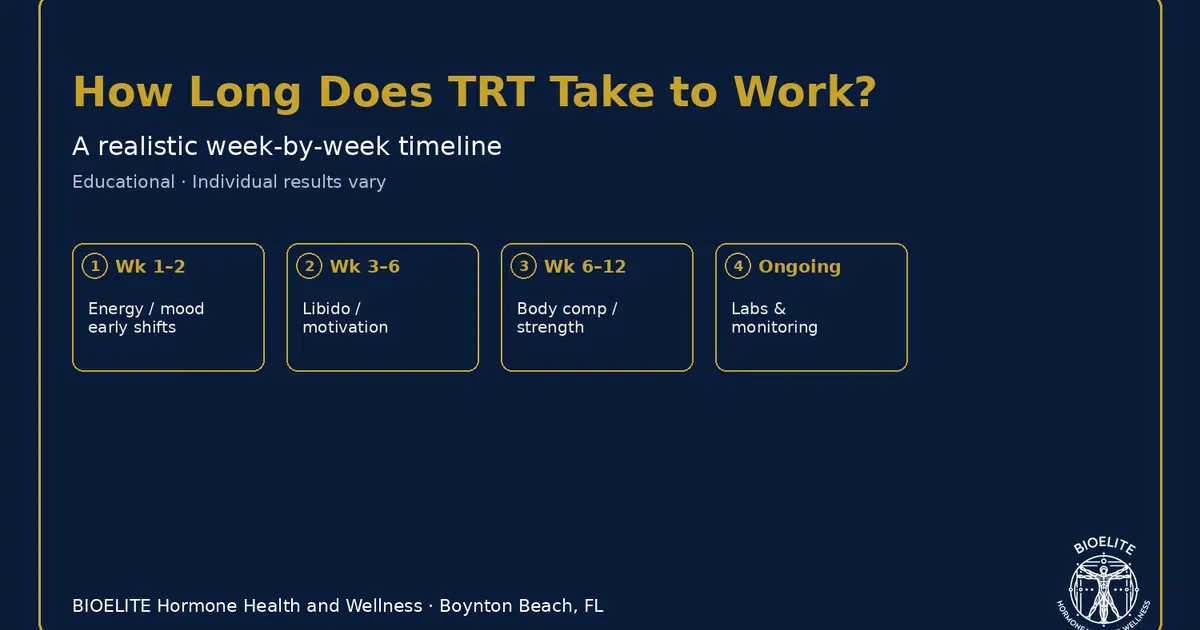
Weeks 1–2: Foundation, not finish line
The first two weeks are usually about establishing the prescription, understanding administration, and noting how you feel day to day. Some people report subtle shifts in sleep or morning alertness; many do not feel a dramatic change yet. That is normal. Early labs are about baseline and safety context—not instant “optimization.”
Weeks 3–6: Early subjective changes
This is the window where many educational sources and clinical reviews describe earlier effects on sexual interest, energy, and quality-of-life measures. Mood and motivation may also begin to improve for some patients, though maximum mood-related benefit—if it occurs—can take longer.
Important framing: early improvement does not mean you skip follow-up. Hematocrit, estradiol context, symptom tracking, and dose timing still matter under medical supervision.
Weeks 6–12: Sexual wellness and consistency
Sexual wellness is multi-factorial. Hormone status is one piece alongside vascular health, stress, relationship factors, and medications. When low testosterone is a contributing factor, desire often moves earlier than full erectile satisfaction. Some men continue refining sexual function over several months. For broader education on intimacy-related care pathways, see BIOELITE’s sexual health page.
By this stage, many clinicians also review follow-up labs to confirm levels are moving into an appropriate clinical range for you—not chasing a social-media number.
Months 3–6: Body composition and training response
Changes in lean mass, fat distribution, recovery between workouts, and waist circumference—if they occur—are more often noticed in this window, especially when training and nutrition support the plan. Insulin sensitivity and lipid trends may also shift gradually; these are monitored with labs rather than assumed.
If body-composition goals are a major priority, ask your care team how hormone work intersects with lifestyle coaching and, when appropriate, medically supervised weight strategies via medical weight management.
Months 6–12 and beyond: Longer-horizon markers
Bone density and some metabolic markers move on a slower clock. Ongoing monitoring helps confirm therapy remains appropriate, side-effect risk stays managed, and goals still match the protocol. Hormone care is a process of adjustment, not a single prescription forever.
What “working” should mean (beyond a single lab number)
A useful TRT conversation tracks both:
Objective markers— total/free testosterone context, CBC/hematocrit, relevant metabolic markers, and other tests your clinician orders
Subjective function— energy, training recovery, libido, mood stability, focus, and daily resilience
Feeling better while labs look unsafe is not success. Perfect-looking labs with no functional change also deserve a thoughtful review. That is why BIOELITE pairs therapy discussions with structured lab pathways and follow-up rather than “set and forget.”
Factors that can slow or confuse your timeline
Inconsistent dosing or missed follow-ups
Poor sleep or untreated sleep apnea
High alcohol intake
Under-fueling or no resistance training when body-composition goals matter
Other hormone or metabolic issues that mimic “low T” symptoms
Unrealistic expectations from social media (overnight transformation claims)
If you are early in research, our FAQ and pricing pages can help you understand process and structure before you book.
How BIOELITE approaches timing and monitoring
BIOELITE Hormone Health and Wellness is a licensed medical facility in Boynton Beach, Florida, working with licensed pharmacies. Care begins with evaluation and labs—not assumptions. Some clients are candidates for direct testosterone support; others may be better suited to approaches that aim to support the body’s own signaling, when clinically appropriate. Your plan should match your labs, symptoms, fertility goals, and preferences.
Clients receive consultant access with no membership fees or surprise subscriptions. Treatment is designed to be flexible: you discuss start/stop decisions with the care team rather than being locked into a hard sell.
Ready for a personalized conversation? Call or text (561) 821-3005, or reach out through Contact BIOELITE. We can walk you through next steps, lab options, and whether testosterone-focused care is even the right path for your situation.
Key takeaways
Most educational timelines place early energy/libido changes around 3–6 weeks for many candidates—not overnight.
Body composition and longer-term markers often need months of consistent, monitored care.
“How long does TRT take to work?” is the wrong question without labs, medical screening, and a plan tailored to you.
Monitoring protects safety and helps refine dosing; it is part of responsible hormone care.
Readers in the area can also learn more about hormone care in Palm Beach County.
Ready to talk with a provider? New patients can book at our online booking page, and existing clients can use our existing-client booking page.
Browse more in our Testosterone & TRT Guides or see all health guides.
Frequently asked questions about how long TRT takes to work
Is there one timeline for TRT?
There is no single overnight switch. Different systems in the body respond on different clocks. Sexual interest and daytime energy often shift earlier, while body composition, recovery, and bone health tend to move more slowly.
Why does TRT not work on one uniform schedule?
Testosterone influences many tissues, including brain pathways tied to drive and mood, reproductive tissues, muscle protein synthesis, red blood cell production, fat metabolism, and bone remodeling. Those tissues do not remodel at the same speed.
What are the first couple of weeks about?
The first two weeks are usually about establishing the prescription, understanding administration, and noting how you feel day to day. Many people do not feel a dramatic change yet.
Why does ongoing monitoring matter?
Ongoing monitoring helps confirm therapy remains appropriate, side-effect risk stays managed, and goals still match the protocol.
Medical disclaimer: Content on the BIOELITE website is for general education about hormone health and wellness. It is not medical advice and does not create a doctor–patient relationship. BIOELITE does not diagnose conditions or prescribe treatments through blog content. Prescription therapies are available only after appropriate clinical evaluation by licensed providers, when indicated. Results vary. Do not start, stop, or change any medication based solely on this article. If you have a medical emergency, call 911.
BIOELITE Hormone Health and Wellness · 1101 N Congress Ave Ste 100, Boynton Beach, FL 33426 · (561) 821-3005 ·BIOELITE website